The Next Big Thing

Hello gentle reader,

I was recently tagged by the lovely Amanda Fanger for The Next Big Thing blog hop and I’m happy to take part since all I have to do is answer questions about my Work In Progress.

What is the working title of your book?

THE LAST QUEEN (Book I in THE DARKLANDS trilogy)

Where did the idea come from for the book?

I started thinking about this story ten years ago. I wanted to write a story where the main character would be a teenage girl (like I was at the time). I also liked the idea of a fantasy land where humans were the lesser people. Finally I wanted to write a love story that would be as realistic as possible, although set in an imaginary land.

What genre does your book fall under?

YA high fantasy.

What is the one-sentence synopsis of your book?

In the dangerous Darklands, a power struggle between Elves, Wolfmen and Humans is igniting, shattering the lives of a young princess, a warrior and a slave boy whose destinies seem meant to intertwine.

Which actors would you choose to play your characters in a movie rendition?

I’m going to cheat for that one 😉 I have no idea who would play my characters on screen, but I can tell you who inspired me while I was writing The Last Queen. I need to have a clear picture of my characters in my head in order to bring them to life, and I’m usually inspired by actors. With that in mind, here goes:

Elian is my main character. He is a 16-year-old slave whose life has been quite traumatic until he meets Araminta. He was directly based on English actor Eddie Redmayne, who was in countless historical movies between 2007 and 2010. Every time I saw him on screen I thought “This is Elian!” So here it is: Elian.

Araminta is 14 years old. She is an Elf, and a Queen. She is strong-willed, smart and quiet. When I described her in my WIP, I thought of English actress Lucy Griffiths.

Theron is 19 years old and he is Araminta’s husband. He is a Wolfman and the son of a lord, who loses all at the beginning of my WIP. He is a short-tempered warrior who happens to be very good-looking. Since I have had a crush on British actor Henry Cavill since, well, forever, I pictured Theron looking like him.

Will your book be self-published or represented by an agency?

Call me crazy, but I’m going for the traditional route.

How long did it take you to write the first draft of your manuscript?

Seven months for the first draft. Then six months for the first round of revision. I have battled with a high word count, instances of telling instead of showing, repetitions, adverbs, passive form and everything you shouldn’t do when you write. I’m still working on this manuscript, hoping one day I will get it in shape for the query process.

What other books would you compare this story to within your genre?

That’s a tough one. If you don’t know what High or Epic Fantasy is, think Game of Thrones and The Lord Of The Rings. But I can’t compare my WIP to those masterpieces. Since it’s YA, I guess it could be compared to The Seven Realms series by Cinda Williams Chima.

What else about your book might pique the reader’s interest?

My favourite character in the book (beside Elian) is Araminta’s bodyguard/slave/assassin Jerod. I actually wrote a short story about him entitled The First Guardian, because I felt he deserved his own story since he is, you know, awesome.

Thanks Amanda for nominating me!

And now, for my nominations… Six special ladies who write Epic Fantasy:

Raewyn Hewitt http://raewynhewitt.wordpress.com/

Mara Valderran http://maravalderran.blogspot.co.uk/

Susan Francino & Tyler-Rose Counts http://thefeatherandtherose.blogspot.co.uk/

Rachel Horwitz http://www.rachelhorwitz.com/blog/

K.L. Schwengler http://myrandommuse.wordpress.com/

ROW80 Check-In 1: Neil Gaiman’s 8 Rules of Writing

Hello gentle reader,

It is time for my first ROW80 check-in! My goals for this fourth round are as follows:

Write or edit every day

Editing – Finish my current round of editing for The Last Queen, get my manuscript critiqued and beat-read, then edit some more.

Writing – Write a short story, and continue writing the first draft of The Cursed King

I’m happy to report that I’ve had a great writing week, since I did manage to write or edit every day! Some days (Tuesday and Friday) were tough because I got home from work very late, but I still stuck to the routine. I also managed to read two books for my upcoming Halloween post and I kept my blog alive with an interview with YA author Meagan Spooner. Check it out if you want to know how she got published.

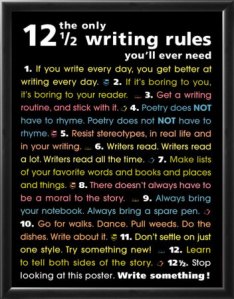
If you’re new to this blog, know that I always add an inspiring story to my ROW80 check-ins. This week, I’m sharing Neil Gaiman’s 8 Rules of Writing that I found on the Guardian website. Neil Gaiman is one of my favourite authors and his writing advice is worth a read.

Image by Kimberly Butler

  1. Write
  2. Put one word after another. Find the right word, put it down.
  3. Finish what you’re writing. Whatever you have to do to finish it, finish it.
  4. Put it aside. Read it pretending you’ve never read it before. Show it to friends whose opinion you respect and who like the kind of thing that this is.
  5. Remember: when people tell you something’s wrong or doesn’t work for them, they are almost always right. When they tell you exactly what they think is wrong and how to fix it, they are almost always wrong.
  6. Fix it. Remember that, sooner or later, before it ever reaches perfection, you will have to let it go and move on and start to write the next thing. Perfection is like chasing the horizon. Keep moving.
  7. Laugh at your own jokes.
  8. The main rule of writing is that if you do it with enough assurance and confidence, you’re allowed to do whatever you like. (That may be a rule for life as well as for writing. But it’s definitely true for writing.) So write your story as it needs to be written. Write it ­honestly, and tell it as best you can. I’m not sure that there are any other rules. Not ones that matter.

How are you other ROWers doing? Here is the Linky to support each other!

ROW80 Round 4 – Goals!

October 1st, 2012 (that’s tomorrow!) is the official start date for Round 4 of A Round of Words in 80 Days (aka ROW80). I have decided to join this writing challenge for the third time. Created by Kait Nolan, ROW80 is “the writing challenge that knows you have a life”, or “the challenge that champions the marriage of writing and real life.” Unlike NaNoWriMo which runs for only a month, each ROW80 round runs for 80 days and the participating writers have to set themselves writing goals for that time. Each Wednesday and Sunday, we check in and let the others know how we are doing. The idea is to form writing habits that writers will hopefully continue once the challenge is over.

As you may know if you follow this blog, my daily life is pretty crazy. I have a day job that keeps me extremely busy, I travel a lot and I read tons of books. Fitting some writing time in my schedule is a challenge, but I’m still very intent on getting published one day.

So here are my goals for this round (and yes, I know they haven’t changed much since the last round, but if at first you don’t succeed…):

Write or edit every day

Editing – Finish my current round of editing for The Last Queen, get my manuscript critiqued and beat-read, then edit some more.

Writing – Write a short story, and continue writing the first draft of The Cursed King

Round Four starts on Monday, October 1st and will end on Thursday, December 20th.

If you would like to join in this writing challenge and become a part of the ROW80 community, here are the rules:

  1. Post a goals post in which you lay out your goals for this round.
  2. Post a check-in post every Wednesday and Sunday, in which you share your progress with the other ROW80 participants.
  3. Comment on other participants’ check-in posts.

Here is the Linky for the other participants’ posts. What are your ROW80 goals for this round?

GUTGAA Pitch Polish

As previously mentioned on this blog, I am taking part in the Gearing Up To Get An Agent blogfest (GUTGAA) hosted by the amazing Deana Barnhart. This week is all about Pitch Polish and you can find my query and the first 150 words of my WIP The Last Queen here. Now, if you’ve read my query or part of my WIP before, know that my manuscript has been undergoing major revisions lately. I have also worked on my query, based on the comments I received a WriteOnCon. So I would be very grateful if you could have a look at my new pitch and give me some feedback on it. I’ll return the favour if you give me a link to your query in the comment section of this post!

And since I hate asking without giving, remember that you can still enter my 100 followers giveaway here and win books!

What is Gritty Epic Fantasy?

Hello gentle reader,

When people ask me what genre my WIP The Last Queen is, I usually reply “Fantasy”. But if I wanted to be precise, I would say “Gritty Epic Fantasy”. Usually I’m not that precise, because then I would have to explain what Gritty Epic Fantasy is and I would end up talking for 15 minutes…

So today I thought I would explain what Gritty Epic Fantasy is, just this once.

Let’s break it down, shall we?

According to Wikipedia,

Fantasy is a genre of fiction that commonly uses magic and other supernatural phenomena as a primary element of plot, theme, or setting. Many works within the genre take place in imaginary worlds where magic is common.

Epic Fantasy is a subgenre of fantasy that is set in invented or parallel worlds.

NB: Because they share so many similarities, Epic Fantasy and High Fantasy are often used as synonyms. In this post, I will not differentiate the two subgenres, although I do think there are some differences that distinguish them.

J.R.R. Tolkien and C.S. Lewis are seen as the founders of the Epic Fantasy subgenre. Both authors invented imaginary worlds where their characters go on a great adventure. Their books focus on a good-versus-evil story and they were published during the first half of the 20th Century.

These books are all about escapism and heroism. In The Hobbit, Bilbo is on a quest to find a treasure guarded by a dragon. In The Lord of the Rings, Gandalf comes back from the dead. In The Chronicles of Narnia, children protect the fictional realm from evil and restore the throne to its rightful line. In these first Epic Fantasy books, there are talking animals, mythical beasts, sword fights, magic at every turn and people rarely die.

As many other readers out there, I love those stories. But Fantasy literature is about being a metaphor for the world we live in. And this is 2012. Since the 1950s, society has changed. Readers have changed. They’ve grown up watching people getting killed live on TV, hearing about horrific cases of child abuse and reading about human trafficking in the paper. When they read Fantasy books, they want to read about characters who face similar challenges to the ones they do.

And that’s what Gritty Epic Fantasy, also known as Realistic Fantasy, has to offer.

The trend was started by Glen Cook’s Black Company series in the mid 1980s. Then George R. R. Martin’s A Song of Ice and Fire series followed in the mid 1990s. And in the last ten years, this subgenre has grown exponentially, with authors such as Joe Abercrombie, Scott Lynch, K. J. Parker, Mark Lawrence, Steven Erikson and Brent Weeks.

In these books, the setting is still imaginary worlds. But instead of relying on complicated magic systems and weird creatures, these stories show us a world in shades of grey, where the characters are as flawed as we are, with the same emotions and reactions. These books touch on concepts which echo in our real world. Martin’s A Song of Ice and Fire tackles politics and relationships, Week’s Night Angel trilogy mentions child abuse and moral ambiguity.

In Gritty Epic Fantasy, there is no old grey-bearded wizard in robes to save the day. No quest to find a hidden treasure. No talking lions and children more powerful than kings. No brave knights who defy death. No world in black and white.

“There’s no guarantee that justice will win out or that a noble sacrifice will make any difference. But when it does, there’s something that still swells my chest. There’s magic in that…. It tells me that’s the way things are supposed to be.”

Brent Weeks, Beyond the Shadows

So maybe Gritty Epic Fantasy is not for you. But I find that this Fantasy subgenre is the one that echoes the most in me and this is what I write.

Some reading recommendations:

Black Company series   (Glen Cook)
A Song of Ice and Fire series  (George R.R. Martin)
Malazan Book of the Fallen series  (Steven Erikson)
The Deed of Paksenarrion  (Elizabeth Moon)
Prince of Nothing series    (R. Scott Bakker)
Acacia  (David Anthony Durham)
The Chronicles of Thomas Covenant  (Stephen R. Donaldson)
First Law series  (Joe Abercrombie)
The Lies of Locke Lamora  (Scott Lynch)

The Night Angel trilogy (Brent Weeks)

Prince of Thorns (Mark Lawrence)

 On the web:

Gritty fantasy

http://bestfantasybooks.com/gritty-fantasy.html

Painting With Grey: The Development and Popularity of “Gritty Fantasy”

http://fantasy-faction.com/2012/painting-with-grey-the-development-and-popularity-of-gritty-fantasy

Why the Turn Towards Gritty Realism In Epic Fantasy?

http://io9.com/5850891/why-the-turn-towards-gritty-realism-in-epic-fantasy-authors-sound-off

So what do you think? Do read or write Gritty Epic Fantasy? Why or why not? I’d love to hear your thoughts!

ROW80 Check-In 5: Susan Dennard’s Advice on Writing a Saleable Book

Welcome gentle reader,

today again I thought I would share with you some writing advice from a published author.

Susan Dennard is a YA author repped by Sara Kendall of NCLit. Her debut novel, SOMETHING STRANGE AND DEADLY, is available now from Harper Teen. Susan has an AWESOME blog where you can find invaluable advice on the craft of writing, on the art of storytelling and revising, on the querying process, on the value of critique partners, on grammar and style and on genres. She regularly writes for the Publishing Crawl blog and you can also find her on Twitter, Goodreads and Facebook.

I really recommend you check out her blog and if you need convincing, I have posted below one of her blog posts entitled Writing a Saleable Book. It was first posted by Susan on the Let The Words Flow website on August 10th 2011. You can read the initial post here.

“Recently, someone asked me:

What is required to make a book saleable?

That is a rather large-in-scope question, and as such, I’m afraid my answer will be kinda vague. All the same, I thought it was worth taking the time to answer for everyone.

My super broad response is the:

The most important thing in writing a saleable book is writing a good book.

I am 100% convinced that if you have a well-written, compelling story, your novel will eventually find an agent/editor. Period.

That said, there are a few critical things that define a “good book”. Again, these answers are vague, and I’d be more than happy to get specific for anyone with questions (ask in the comments, please!).

Parts of a Good Book

1. First and foremost, the story absolutely most flow. Stilted dialogue, poor pacing, or unreadable grammar/syntax will kill a manuscript. A reader can put up with slow scenes if it all flows beautifully, and a reader can put up with a less-than-compelling plot if it’s smooth.

The way to ensure your novel flows is to revise-revise-revise. Learning to master the written word is absolutely critical. Few people write stunning first drafts, but give them a red pen, and they can line-edit their words into perfect prose.

2. Secondly, a book needs a compelling plot with tension on every page. The story builds, the tension builds, and everything ends in an explosive climax (and this applies to any genre—by explosive I simply mean all aspects of the story finally come together).

This is something you can learn by reading about writing, taking workshops, or simply reading heavily in the genre you write. There are structure to stories (three-act is the most common), and your job is to practice until these are second nature when you write/revise.

Again, my first drafts are rarely good examples of compelling plot, but I can revise them until they shine and all the subplots weave into the main plot.

3. Third, a book needs a cast of characters that readers care about. The best way to achieve this is to ensure the MC has a desperate need—secondary characters too. This is also something you have to learn by doing/practicing.

4. Fourth, the book must have high stakes. “High stakes” simply means we are invested in whether or not the MC achieves his/her goal. What will she lose if she fails to reach her goal? And why does that matter? A common reason a book fails to compel readers is low stakes—if we don’t care about the MC’s failure, we don’t care about reading the book.

Finding Problems

My biggest suggestion in terms of how to address these 4 components is to start critiquing and getting your work critiqued. Either find a critique partner, join a critique group, or stay active in a critiquing community. This is no doubt something everyone here already knows, but it’s so important (in my opinion) that I just have to emphasize it!

When you see others make mistakes, you learn to spot them in your own writing. Additionally, we, the writers, are often too close to our novels to see them “as a whole”. CPs and betas have the needed distance to spot problems

When I got an agent, Something Strange and Deadly had been through 4 crit partners and 2 betas. Did I always listen to my CPs’/betas’ comments? No—you must decide and filter feedback—but it was thanks to my CPs/betas that I caught some of my biggest mistakes (character inconsistencies, flat climax, plot holes, etc.).”

I hope this post by Susan helped!

Now for my ROW80 goals:

After 10 days off (I was travelling) I have been somewhat back on track for the past three days.

1-          Write everyday: 3/7 days.

2-          Self-edit The Last Queen: done.

3-          Continue writing the first draft of The Cursed King: done.

Here is the Linky for the other check-in posts. How are you other ROW80 writers doing?

Hookers and Hangers Blogfest (updated)

Hosted by Falling For Fiction, the Hookers and Hangers Blogfest aims at getting writers to post the first lines (hooks) and last lines (hangers) of their chapters from their current WIP. We can post as many as we like, and the judges (the Falling For Fiction ladies) will be judging everyone’s first three hookers and first three hangers. They will each pick two winners (MOST ENTICING HOOKER and MOST IMPOSSIBLE HANGER) making a total of ten winners… Winners will receive a 10 page (double spaced) critique and a Friday Spotlight on Falling For Fiction.

So, without further ado (especially since I’m late to this party), here are my first lines from the first 3 chapters of my WIP THE LAST QUEEN (YA High Fantasy):

Pitch:

In the Darklands, a power struggle between Vampires, Wolfmen and Humans is igniting, shattering the lives of a young princess, a warrior and a slave boy whose destinies seem meant to intertwine.

First lines:

“The door slammed open behind Araminta and she felt a hand press against her mouth.”

“Theron shook off his fear and tried to gather his thoughts.”

“Elian felt a splash of cold water against his face and a hard slap.”

*Wednesday update: here are the hangers from the last four chapters of THE LAST QUEEN…*

Last lines:

“Theron had granted him his freedom because he had known from the start that he would die in the City of Light.”

“But before he had time to realise what he was doing, he collapsed on the muddy ground and felt everything disappear.”

“Come on, Araminta,” Rowan urged her in a murmur. “Bring him back with you.”

“It was a perfect day, and he was in love with a queen.”


This is a blog hop, so make sure to visit the other writers’ blogs here. And feel free to comment!

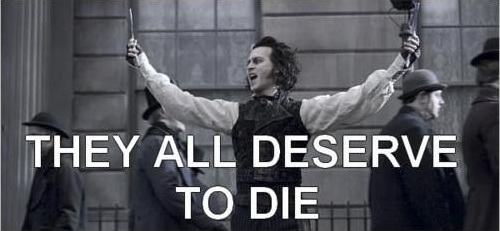
Valar Morghulis : On killing your characters

Hello gentle reader,

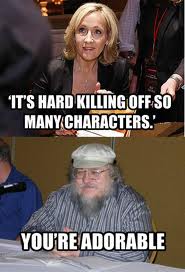
for this second ROW80 check-in, I thought I would tackle the issue of killing characters in novels. Let’s say you’ve created a number of interesting and believable characters in your WIP. Is killing off one or all of them going to help or harm your novel?

Over the past few months I have had to consider this question for two reasons:

–          one of the main characters in my epic fantasy novel The Last Queen dies at the end of the book and some of my beta readers have protested against such a death.

–          I have come across several serial stories where killing off characters was an over-used writing device and it made me wonder when killing your characters actually damages your story rather than makes it go forward.

I am not talking here about the horror genre, where killing off all the characters one by one is an expected writing device. I am talking about the other genres, especially Fantasy and Historical Fiction.

The first example of a story where no one is safe is A Song of Ice and Fire by G.R.R. Martin. One of the catch phrase used in this series of books is actually “Valar Morghulis”, which can be translated as “all men must die”. In the books (as well as in the TV show Game of Thrones that is aired on HBO since 2011), a great number of the major characters die, often brutally and unexpectedly.

The second example I have come across recently is the Starz TV show Spartacus, created by Steven S. DeKnight and Robert Tapert. In this historical drama, the writers’ motto is “Kill Them All”, which translates into the death of almost every single character, save for Spartacus himself.

So I get why killing off characters can be a useful writing device. When the reader has become invested in sympathetic characters, it is always a great emotional shock to see those beloved characters die, especially if those deaths are paired with acts of bravery and/or selflessness. For the writer, the death of a character can also be a great way to move the plot along. For example, at the beginning of the second season of Supernatural (a CW TV show), the death of the heroes’ father was a great way to get the story forward. In the Harry Potter series, the deaths of Sirius Black (in Harry Potter and the Order of the Phoenix) and Albus Dumbledore (in Harry Potter and the Half-Blood Prince) were impressive plot devices that made the young characters grow up and move forward despite their grief.

What I am questioning here, however, is the over-use of the device. In a way, G.R.R. Martin and the writers of Spartacus have painted themselves into a corner, because their readers/viewers now know that they shouldn’t invest too much in characters that are going to die anyway. Also the element of surprise is gone: when you get to Book 5 of A Song of Ice and Fire, you basically expect everyone to die. In this case, the reader/viewer feels cheated because instead of being presented with a great plot and believable tragic events, he is faced with yet another character’s death that doesn’t stir any emotion in him and harms the plot instead of moving it forward.

So what do you think? Do you read or write stories in which everybody dies?

Before wrapping up this post, a few words about my ROW80 goals:

1-      Write everyday: 5/7 days. This week I wrote every day except for Thursday and Friday when my day job took over my life.

2-      Self-edit The Last Queen: not exactly done. I have actually added a few scenes to the novel instead of editing it down. Argh.

3-      Continue writing the first draft of The Cursed King: done, but only a few hundred words.

Here is the Linky for the other ROW80 participants. How have you been doing?

A Round of Words in 80 Days – Round 3 – Check-in #1

Hello gentle reader,

My blog is four months old today! And I am very close to have 100 followers, how exciting is that?! Thanks to everyone who has supported me and this blog in the past few months. You’ve made this blogging endeavour worth it…

So it is now July and I have decided to join the awesome writing challenge that is A Round of Words in 80 Days (aka ROW80) for the second time. Created by Kait Nolan, it is “the writing challenge that knows you have a life”, or “the challenge that champions the marriage of writing and real life.” Unlike NaNoWriMo which runs for only a month, each ROW80 round runs for 80 days and the participating writers have to set themselves writing goals for that time. Each Wednesday and Sunday, we check in and let the others know how we are doing. The idea is to form writing habits that writers will hopefully continue once the challenge is over.

Thus after my JuNoWriMo debacle (during which I have learned that one cannot spend an average of 9.1 hours per day at work AND write a 50.000 words novel), I am back to doing a writing challenge that will actually fit into my crazy daily schedule.

So here are my goals for this round:

1-      Write everyday

2-      Self-edit The Last Queen

This was one of my goals for the last round and I did complete it, however since then I have heard Back from a few beta readers/agents and I have some new editing to do.

3-      Continue writing the first draft of The Cursed King

This is the second book in my DARKLANDS epic fantasy trilogy (more info here) and I really want to finish a first draft during this round.

Round Three starts on Monday, July 2nd and will end on Thursday, September 20th.

If you would like to join in this writing challenge and become a part of the ROW80 community, here are the rules:

  1. Post a goals post in which you lay out your goals for this round.
  2. Post a check-in post every Wednesday and Sunday, in which you share your progress with the other ROW80 participants.
  3. Comment on other participants’ check-in posts.

Here is the Linky for the other participants’ posts. What are your ROW80 goals for this round?

ROW80 Check-In #8

Hello gentle reader,

I’m late for this check-in, as I have just returned from London (for those of you who don’t live in the UK, we enjoy a four-day weekend here for the Queen’s Diamond Jubilee). Also this is my last ROW80 check-in for this round, as I’m now done with my one and only goal:

self-edit my YA Fantasy novel The Last Queen.

I’m so happy I am done with this I could sing.

And now that The Last Queen is off living its own destiny, I’m now focusing on the JuNoWriMo challenge: my goal is to write every day, even if I don’t make the 50,000-word goal.

So thank you, fellow ROW80ers, this has been very formative for me.

And let’s not forget the Linky

Have a great week and happy writing!