A Writer in the Spotlight – Susan Dennard

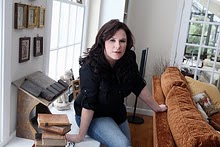
Something Strange and Deadly, a YA historical novel with zombies and a steampunk vibe, is out TODAY! And I have the pleasure to interview debut author Susan Dennard about the release and her writing process. As a reminder, the idea behind the “Writer in the Spotlight” feature is that published authors are the best source of advice for us, would-be-published writers.

Author : Susan Dennard

Genre : Young Adult, Fantasy

Location: Germany

Website: http://susandennard.com

Official Book Trailer: http://www.youtube.com/watch?v=bnQuHXPTUP0&feature=youtu.be

Goodreads: http://www.goodreads.com/author/show/4499623.Susan_Dennard

Twitter: www.twitter.com/stdennard

Books : Something Strange and Deadly series: Something Strange and Deadly (2012), A Darkness Strange and Lovely (2013) from Harper Teen.

My interview (22/07/2012):

On writing

Did you always know you wanted to be a writer?

I can’t say that I ALWAYS knew. I didn’t start putting my daydreams onto paper until I was around 13 or so. After that, all my dreams of a becoming a marine biologist vanished in my obsession with writing (though I was a TERRIBLE writer). Of course, I was such a snotty teen, though, that I refused to be taught–I didn’t want to learn to write since I thought I was already amazing. Ha! Then, when I went off to school to major in creative writing, I got side-tracked by marine biology. Funny how those things work!

I still love science and the marine world. College and graduate school were amazing experiences. In fact, the only reason I returned to writing was because my husband and I would have to live apart if I pursued my PhD. So–rather than separate–I moved with him to Germany, started writing (and studying the craft of writing) full-time, and the rest is history! 😉

When and where do you write?

I write in my office everyday. Or…I do something writing-related everyday. I’m very strict about this. My rule is that if my husband is working, I ought to be too! So either I’m BICHOK-ing (butt-in-chair, hands-on-keyboard), revising, or working on “administrative stuff” (emails, blogging, self-promotion, etc.).

What do you say to people who want to be writers?

Do it! Sit down and write. That’s the only way to achieve your dreams–but make sure you dream big too! I think success is three-part: aiming high, working hard, and not giving up. It’s so EASY to let dreams slide away when things take a while or don’t work out as you’d hoped. But you CAN’T give up. My mantra before I was published and to this day is: “It’s not a race. You know what you want, Sooz, so just keep on plugging away until you get there.”

I want to share my stories with as many people as possible, and so that’s what I’m trying to do!

On Something Strange and Deadly

To write this book, where did you get your inspiration from? (How did you come up with a historical novel with zombies?!)

Well, the initial premise came from a dream. My brother was missing; I knew I’d do anything to save him; and the only people who could help  mewere a ragtag team of outcasts. I took that idea and fleshed it out. I knew I wanted a paranormal/creepy element, and I settled on ghosts and corpses after rummaging through what scared me most! It sounds so silly, but honestly, I scanned my shelves trying to pick out which books made my skin crawl. If I was scared, then surely I could transfer that fear onto the page–and nothing creeps me out more than ghouls and zombies!

The historical aspect–specifically 1876–came about because I knew I wanted a steampunk vibe (but not 100% steampunk). I adore 19th century literature and history, and after some preliminary research, I discovered the Centennial Exhibition (the first American World’s Fair). I thought, “Whoa! What a great place for walking corpses! What if…what if my team of outcasts are actually zombie-fighters brought in to protect the Exhibition?”

And that, my friends, is how Something Strange and Deadly came to be.

Why did you choose to write for young adults?

I’m not sure I ever consciously set out to write YA…I just knew I wanted to write a book that I would love. And of all the books I’ve read, the ones that stay with me the most are the books I enjoyed growing up and during my teen years. I knew I wanted to write THAT sort of book, and so…I did! 🙂

 What are you working on now?

Right now, I’m writing the third book in the Something Strange and Deadly series (so weird to work on it when book 1 isn’t even out yet!) as well as a novella set before the events in the trilogy. I’m also working on some other projects–Screechers, an epic fantasy in a desert world; an untitled space opera with author Sarah Maas (Throne of Glass, Bloomsbury 2012); and a fluffy, fun contemporary.

You can buy Something Strange and Deadly on Amazon here. And you can enter the Something Strange and Deadly Outbreak giveaway here.
ROW80 Check-In 4: Rebecca Maizel’s Top Ten Tips for Budding Writers

Welcome gentle reader,

For this fourth ROW80 Check-In, I want to share with you a post first published by Rosanna MKB Digital on the My Kinda Book website on July 17, 2012. It gives YA bestselling author Rebecca Maizel’s top 10 tips for writers and I find it highly inspirational. Feel free to check out the original post here and to visit Rebecca’s blog here.


“10. Read aloud. What sounds good in your head has a different rhythm when read aloud. Dialogue especially. Read aloud before you give your manuscript to your trusted readers.

9. When you are revising your manuscript, pick out the metaphors, similes, and personification. Make sure they are original and that they add to the theme of your story.

8. If you want to write, you must read. Read! Read! Read! Read stories that you don’t think will interest you. Be surprised. Be inspired by other people’s genius.

7. Don’t give your work to your friends unless these friends are writers or he or she loves to read. They love you so they will lie to you. Give your work to friends who want to see you write incredible stories and will give you the hard critique so your work improves.

6. Read what’s in the market. “I don’t read” is a phrase I hear a lot from young people. How can you write a story if you don’t study story?

5. Do a read of your manuscript and circle the amount of times you wrote, “I felt.” Then revise as many of those sentences as you can without that phrase. Show the feeling, don’t tell the feeling. We want to experience it with the character.

4. Avoid laundry lists of description. Example: Rebecca Maizel wore black pants, a black shirt, and black heels. Her hair was styled up and it was dark brown. BOOOOOOOOORING.

3. Please give your villains motivation! A villain who is evil for no reason isn’t believable. Even Darth Vader had a good side. Everyone, even those who challenge us are three-dimensional. It’s even scarier if you can bring them to life in fiction.

2. Every main character must have a want – a desire. If you can’t answer this statement: My character wants _________, then you don’t have a story. If nothing is at stake, your readers will stop reading.

1. Write what you love. Because you have to. Because without this story you won’t be living a fulfilled life.”

Now for my ROW80 goals:

1-     Write everyday: 5/7 days. This week AGAIN I wrote every day except for Tuesday and Wednesday. Getting to 7/7 is hard.

2-      Self-edit The Last Queen: done. A little bit.

3-      Continue writing the first draft of The Cursed King: not done this week.

Also, this week on my blog, you could:

–     read the first and last lines of my current WIP. Comments are welcome!

–     read an exclusive interview with YA author Lisa M. Stasse about her writing process.

Here is the Linky for the other check-in posts. How are you other ROW80 writers doing?

Hookers and Hangers Blogfest (updated)

Hosted by Falling For Fiction, the Hookers and Hangers Blogfest aims at getting writers to post the first lines (hooks) and last lines (hangers) of their chapters from their current WIP. We can post as many as we like, and the judges (the Falling For Fiction ladies) will be judging everyone’s first three hookers and first three hangers. They will each pick two winners (MOST ENTICING HOOKER and MOST IMPOSSIBLE HANGER) making a total of ten winners… Winners will receive a 10 page (double spaced) critique and a Friday Spotlight on Falling For Fiction.

So, without further ado (especially since I’m late to this party), here are my first lines from the first 3 chapters of my WIP THE LAST QUEEN (YA High Fantasy):

Pitch:

In the Darklands, a power struggle between Vampires, Wolfmen and Humans is igniting, shattering the lives of a young princess, a warrior and a slave boy whose destinies seem meant to intertwine.

First lines:

“The door slammed open behind Araminta and she felt a hand press against her mouth.”

“Theron shook off his fear and tried to gather his thoughts.”

“Elian felt a splash of cold water against his face and a hard slap.”

*Wednesday update: here are the hangers from the last four chapters of THE LAST QUEEN…*

Last lines:

“Theron had granted him his freedom because he had known from the start that he would die in the City of Light.”

“But before he had time to realise what he was doing, he collapsed on the muddy ground and felt everything disappear.”

“Come on, Araminta,” Rowan urged her in a murmur. “Bring him back with you.”

“It was a perfect day, and he was in love with a queen.”


This is a blog hop, so make sure to visit the other writers’ blogs here. And feel free to comment!

ROW80 Check-In 3 On the importance of feedback and beta readers

Welcome gentle reader,

Week 2 of ROW80 (Round 3) has ended and today I wanted to mention the importance of getting feedback on your WIP.

Because writing your novels in a vacuum can only take you so far, there is always a time when you need beta readers in order to make some progress.

“What are beta readers?” you may ask.

According to Wikipedia, “the author or writer, who can be referred to as the alpha reader, may use several beta readers prior to publication. A beta reader (…) can serve as proof-reader of spelling and grammar errors or (…) work on the “flow” of prose. In fiction, the beta reader might highlight plot holes or problems with continuity, characterisation or believability.”

So, I’ll admit it, sending off your Precious Manuscript to beta readers can be scary. No one wants to hear their writing is dreadful and their WIP should be revised from start to finish.

But you need to take that plunge in order to know what your WIP is really worth and to make the appropriate corrections BEFORE you send your Masterpiece to a dozen agents.

Indeed, it is essential to query agents with a manuscript that is in the best possible form in order to maximize your chances of success. If you follow US literary agent Sara Megibow’s #10queriesin10tweets on Twitter, you’ll notice that she receives 200 submissions A DAY. And out of those, she often comments that the writing is “poor” or “weak” or “unclear”. You don’t want to be one of those writers, do you?

So to avoid such rejection, you need to find beta readers who will critique your query/novel/short story. They will find writing issues and they will tell you about it so you can fix them.

Now, how to choose your beta readers?

Even if I’m going against the flow here, I’ll say start with your family and friends. Often, you’re told not to do this because you need critique, not praise, and your relatives tend to just tell you that you are the next big thing. Or they laugh at you. However I have found that getting some of my friends and family members to read my WIP is worth it. Firstly they are all non-writers and they are readers of published YA novels, so it is interesting for me to get their reactions on my own YA novels. One of the earliest comments I got from one of these beta readers was that my WIP was “like a real book.” It was very encouraging for me to hear that my novel could be compared to published YA books. These non-writer beta readers will tell you if your WIP is boring or impossible to understand, if they liked your characters and if they enjoyed reading your story. That’s the first step.

Then you need to find beta readers who are writers themselves. These beta readers are valuable because they will spot writing issues more easily. They will tell you about spelling and grammar errors, about plot issues etc. You can find these beta readers through a writing group, an online community or via your social media platform.

This feedback may or may not be what you want to hear? But if you listen to what your beta readers have to say, you’ll improve your chances of getting published.

Some interesting articles on beta reading:

Susan Dennard http://susandennard.com/2010/05/18/975/

Diary of a Random Fangirl http://therandomfangirl.wordpress.com/2012/04/04/writing-wednesdays-the-importance-of-beta-readers/

Bryan Thomas Schmidt http://bryanthomasschmidt.net/2011/05/21/6-tips-for-being-a-good-beta-reader/

To wrap up this post, my ROW80 progress this week:

1-     Write everyday: 5/7 days. This week I wrote every day except for Tuesday and Saturday. A special thanks to Lauren Garafalo for leading ROW80  sprints on Twitter, they really help!

2-      Self-edit The Last Queen: done. A little bit.

3-      Continue writing the first draft of The Cursed King: not done. Instead I wrote a short story.

Also, this week on my blog, you could:

–       find out how NOT to start your novel or how hook your reader from the first paragraph.

–     read an exclusive interview with YA author Kendare Blake about her writing and how she got her best-selling ghost story Anna Dressed In Blood published.

Here is the Linky for the other check-in posts. How are you other ROW80 writers doing?

A Writer in the Spotlight – Kendare Blake

This week again I was lucky enough to have a YA author give me an exclusive interview! The idea behind the “Writer in the Spotlight” feature is that published (and bestselling) authors are the best source of advice for us, would-be-published writers. Today’s interview is with the ever awesome Kendare Blake, whose YA ghost story Anna Dressed In Blood is one of my favourite books.


Author : Kendare Blake

Genre : Young Adult, Paranormal, Ghost story, Horror

Website : http://kendareblake.com/

Blog: http://kendare-blake.livejournal.com/

Twitter: http://twitter.com/KendareBlake

Books : The Anna series: Anna Dressed In Blood (2011), Girl of Nightmares (released August 7th, 2012)

                  Sleepwalk Society (2010)

                   Antigoddess (released 2013)

My interview (13/07/2012):

On writing:

Did you always know you wanted to be a writer?

Yes. Though I didn’t think of it as a practical option after I graduated from high school. I still didn’t think it was a practical option when I decided to do it after grad school. But by then I’d come to terms with the idea of being a starving artist.

When and where do you write?

I write when I have spare time. And after I’ve done everything else that could possibly need doing. (Master procrastinator!) My office is in my apartment and consists of a kitchen table, a printer, my laptop, stacks of books and sheafs of paper.

Do you ever experience writer’s block?

No! And now I must go find wood and knock on it, and pet my black cat backwards.

What do you say to people who want to be writers?

Excellent! Books books and more books. The world needs ’em.

Can you tell us a little bit about your publishing journey? (the different steps and how long it took you to be published)

I’ll tell you Anna’s story. Which was not the first book I wrote, or the first book I sold. The first book I wrote (seriously wrote, not wrote during childhood) was the first book I sold, but it took forever.

I wrote Anna in about eight months. Queried agents for about two months. Got a few requests for fulls, and some rejections. Ended up with two offers of representation, both from amazing agents. One a smaller more boutique agent, and another with the backing of a big agency. Talked with both of them. Ended up going with the smaller agency. Anna went out on submission and was out for about three months. I think. We started getting nibbles around the month and a half mark. Some rejections. Went to a few editorial boards. Wound up with two offers, so I guess you’d call that a mini-auction. I went with Mel Frain, at Tor Teen, and she’s excellent and bodacious. Anna sold in April, 2010 and pubbed in August 2011.


On “Anna Dressed In Blood”:

What made you choose to write a ghost/horror story?

I wanted to play Silent Hill but was too scared. And I missed reading Stephen King and Anne Rice. When I was in London, I’d rekindled my love of the fantastic, with Joe Hill and Angela Carter.

What is striking about your book is its voice. Did you work a lot on that or did it come to you naturally when you started writing the book?

Cas’ voice came naturally. I can’t imagine how hard it would have been if it hadn’t. He was real from the moment he hit the page. If he hadn’t been, I probably would’ve stopped.

To write this book, where did you get your inspiration from?

No idea. Anna’s name came to me first. Anna Dressed in Blood. And I thought, who’s that? Oh of course. She’s a dead girl who kills people. Hmm. Someone ought to kill her.

Cas is awesome. Anna is amazing. How did you come up with those characters?!

They sort of came up with themselves. I knew what Anna was, but not exactly who. She was a murderous ghost. A real badass. That side was easy. Her human part didn’t reveal until later. I knew Cas was a ghost hunter, with a knife. I knew he’d go after her, and that he was a loner. That’s about it.

What type of music did you listen to when you wrote this book?

I didn’t! I can’t write and listen to music that often. I usually end up just jamming, and nothing gets done.

What are you working on now?

Right now is that wonderful phase of juggle city! I’m halfway through the second book in my new series and the first one comes back ready for edits. So I’m putting aside the second this week to polish up the first.

The new series kicks off with ANTIGODDESS next August. It’s Greek gods in the modern world. Athena and Hermes and Odysseus and Cassandra. Dying gods at war and the teens who get caught in their mess. Very, Terminator. Or Terminator 2. Maybe just very Sarah Connor.


Reading advice:

Which authors inspire you now? Any YA books you would recommend?

Right now I’m halfway through WE HAVE ALWAYS LIVED IN THE CASTLE by Shirley Jackson. Not YA exactly but holy shit. How have I not read this before? It’s a flipping masterpiece. Ominous and so beautiful. On the YA side I’m consistently inspired by the short stories of Holly Black, and by loads of others. I’d recommend reading her collection THE POISON EATERS and also…well, it depends what you’re in the mood for. Suzanne Young’s A NEED SO BEAUTIFUL is amazing. The sequel, A WANT SO WICKED is out now. Kristen Simmons’ ARTICLE 5 is harrowing. Deb Caletti’s STAY from last year…so many more!

Thanks for the interview Kendare!

Thank you for having me by the blog! And for the fun interview questions 🙂

Girl of Nightmares will be out on August 7th, 2012. Buy it on Amazon here.

Friday Film – Frozen

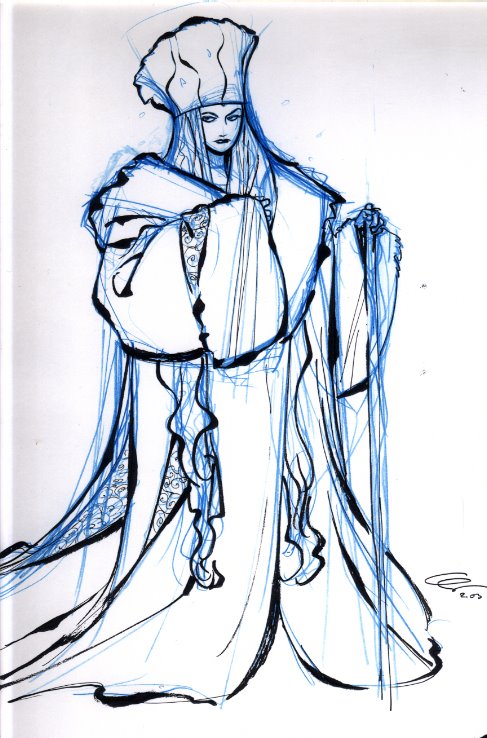
This week, I would like to mention a film that I cannot wait to see: Frozen (Walt Disney Animation Studios’ 2013 animated feature holiday film). Based on The Snow Queen by Hans C. Andersen, the movie will be “an epic tale of adventure and comedy”.

According to the official press release from 11th June 2012, the film is set to be released on 27th November 2013.

“In Frozen, a prophecy traps a kingdom in eternal winter, so Anna (voice of film/TV/stage star Kristen Bell), a young dreamer about to take the adventure of a lifetime, must team up with Kristoff, a daring mountain man, on the grandest of journeys to find Elsa the Snow Queen (voice of Tony Award ®-winning actress Idina Menzel) and put an end to the icy spell. Encountering Everest-like extremes, mystical creatures and magic at every turn, Anna and Kristoff battle the elements in a race to save the kingdom from destruction.

Directed by Chris Buck (“Tarzan,” “Surf’s Up”) and produced by Peter Del Vecho (“Winnie the Pooh,” “The Princess and the Frog”) and by Pixar’s John Lasseter, “Frozen” will feature original songs by Broadway greats Robert Lopez and Kristen Anderson-Lopez.”

So, not only is this film based on an amazing fairy tale, but it will also include the voices of two of my favourite actresses in the world?

Allow me to swoon. I just cannot wait.

What about you? Do you have a film that you’re eagerly anticipating? Let me know in the comment section!

Waiting on Wednesday – 15

“Waiting On Wednesday” is a weekly event, hosted by book blogger Breaking The Spine, that spotlights upcoming releases that we’re eagerly anticipating.

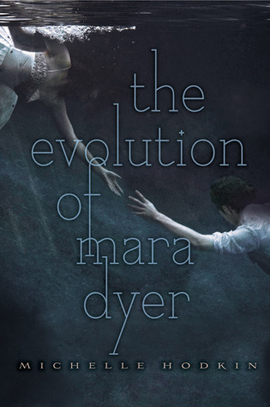
This week I’m waiting on The Evolution of Mara Dyer (Mara Dyer #2) by Michelle Hodkin (Expected publication: October 23rd 2012 by Simon & Schuster Books for Young Readers). This is book 2 in the Mara Dyer series and I CANNOT WAIT to read it! The Unbecoming of Mara Dyer is undoubtedly one of my favourite YA books and I really want to know what happens next to Mara and Noah.

From Goodreads:

“The truth about Mara Dyer’s dangerous and mysterious abilities continues to unravel in this gripping sequel to the thrilling “The Unbecoming of Mara Dyer.” One week after Mara walked into a police station in Miami at the close of “The Unbecoming of Mara Dyer,” she has been committed to psychiatric treatment for what her parents believe was a mental breakdown. But what seems like a hallucination to everyone else is a chilling reality for Mara. Someone from her past has discovered her strange, deeply disturbing secret and that someone wants her to pay. But when no one believes the truth, Mara is totally helpless. The only person on her side is Noah Shaw, as sexy and handsome as he is loyal and cunning. Noah is the only person who can help Mara–as long as he doesn’t get himself killed in the process.”

Visit Michelle’s blog here.

What are you waiting on this week?

Openings : how not to start your novel

A few tips I picked up along the way on how not to mess up your novel from the start… or on how to hook your reader with your first paragraph.

What you shouldn’t start your novel with:

–          The weather report: “It was warm and cloudy with a chance of scattered showers on the day Harry and Sally met.” Just start with Harry meeting Sally and include the weather later.

–          A dream: “… And then Sally woke up.” Let us start with something actually happening, shall we?

–          Your main character waking up and proceeding to having a normal day: “It was a day like any other day and Sally woke up, got out of bed, hopped in the shower and got dressed like she did every day. Little did she know that it was the day her life was going to change…” Just fast forward to the actual life-changing event.

–          A description of your novel’s setting: “Once upon a time, in a land where there were deep forests, green pastures and mirror-like lakes…” Action must come first, THEN the setting and world-building.

–          A page-long dialogue: “You’re joking”, Sally said. “No, I’m not,” Harry replied. “It is true, I swear. Just ask Marny.” “I don’t believe you,” Sally retorted. “I wish you did,” Harry insisted.” Meanwhile, the reader has no clue what’s going on and doesn’t really care.

–          Your main character running: “Sally was running through the woods and she could hear the beast not far behind her.” Sure, it is an in medias res situation. But it has been done so many times before and you can be much more original.

–          A sex scene: “Sally screamed with pleasure and collapsed on Harry’s muscular body.” Unless you’re writing erotica or romance, this is to be avoided on your first page.

–          A prologue that gives away the ending: “Sally was running through the woods, knowing she had no way of escaping Harry’s murderous intent. Yet when they had met six months before, she would have never guessed their relationship would end like this.” The fact that Twilight has such a prologue doesn’t mean you have to do it too.

What you should start your novel with:

–          A catchy first sentence : “Most people would probably call me a ghost. I am, after all, dead. But it wasn’t so long ago I was alive, you see. I was just 18. I had my whole life in front of me.” Remember Me by Christopher Pike.

–          An In Medias Res (“in the middle of things”) situation: “There was a hand in the darkness, and it held a knife.” The Graveyard Book by Neil Gaiman.

What you could start your novel with:

–          Your main character waking up and everything is different: “When I wake up, the other side of the bed is cold.”  The Hunger Games by Suzanne Collins.

–          A meaningful prologue: “A mile above Oz, the Witch balanced on the wind’s foreward edge, as if she were a green fleck of the land itself, flung up and sent wheeling away by the turbulent air.” Wicked: The Life and Times of the Wicked Witch of the West by Gregory Maguire

–          One sentence from a dialogue followed by some narration: “I SEE …” said the vampire thoughtfully, and slowly he walked across the room towards the window.” Interview with the Vampire by Anne Rice.

So how does your novel start? Have you avoided all the above pitfalls ? Do you think these ‘rules’ for opening are worth following? Leave me a comment, I’d love to hear your thoughts!

Valar Morghulis : On killing your characters

Hello gentle reader,

for this second ROW80 check-in, I thought I would tackle the issue of killing characters in novels. Let’s say you’ve created a number of interesting and believable characters in your WIP. Is killing off one or all of them going to help or harm your novel?

Over the past few months I have had to consider this question for two reasons:

–          one of the main characters in my epic fantasy novel The Last Queen dies at the end of the book and some of my beta readers have protested against such a death.

–          I have come across several serial stories where killing off characters was an over-used writing device and it made me wonder when killing your characters actually damages your story rather than makes it go forward.

I am not talking here about the horror genre, where killing off all the characters one by one is an expected writing device. I am talking about the other genres, especially Fantasy and Historical Fiction.

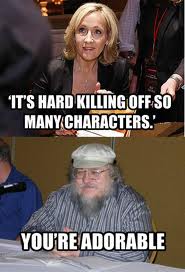
The first example of a story where no one is safe is A Song of Ice and Fire by G.R.R. Martin. One of the catch phrase used in this series of books is actually “Valar Morghulis”, which can be translated as “all men must die”. In the books (as well as in the TV show Game of Thrones that is aired on HBO since 2011), a great number of the major characters die, often brutally and unexpectedly.

The second example I have come across recently is the Starz TV show Spartacus, created by Steven S. DeKnight and Robert Tapert. In this historical drama, the writers’ motto is “Kill Them All”, which translates into the death of almost every single character, save for Spartacus himself.

So I get why killing off characters can be a useful writing device. When the reader has become invested in sympathetic characters, it is always a great emotional shock to see those beloved characters die, especially if those deaths are paired with acts of bravery and/or selflessness. For the writer, the death of a character can also be a great way to move the plot along. For example, at the beginning of the second season of Supernatural (a CW TV show), the death of the heroes’ father was a great way to get the story forward. In the Harry Potter series, the deaths of Sirius Black (in Harry Potter and the Order of the Phoenix) and Albus Dumbledore (in Harry Potter and the Half-Blood Prince) were impressive plot devices that made the young characters grow up and move forward despite their grief.

What I am questioning here, however, is the over-use of the device. In a way, G.R.R. Martin and the writers of Spartacus have painted themselves into a corner, because their readers/viewers now know that they shouldn’t invest too much in characters that are going to die anyway. Also the element of surprise is gone: when you get to Book 5 of A Song of Ice and Fire, you basically expect everyone to die. In this case, the reader/viewer feels cheated because instead of being presented with a great plot and believable tragic events, he is faced with yet another character’s death that doesn’t stir any emotion in him and harms the plot instead of moving it forward.

So what do you think? Do you read or write stories in which everybody dies?

Before wrapping up this post, a few words about my ROW80 goals:

1-      Write everyday: 5/7 days. This week I wrote every day except for Thursday and Friday when my day job took over my life.

2-      Self-edit The Last Queen: not exactly done. I have actually added a few scenes to the novel instead of editing it down. Argh.

3-      Continue writing the first draft of The Cursed King: done, but only a few hundred words.

Here is the Linky for the other ROW80 participants. How have you been doing?

The Lucky 7 Meme

This week I was tagged in the Lucky 7 meme by the lovely Belle DiMonté.

Here are the rules:

1) Go to page 7 or 77 from your current WIP (work in progress)

2) Go to line 7

3) Copy down the next 7 lines–sentences or paragraphs–and post them as they’re written. No cheating!

4) Tag 7 authors and let them know

So here is an excerpt from The Last Queen, which I am currently editing:

She pushed a cup toward him and raised her own.

“To the God of Light!”

Then she drank her wine. Elian didn’t even move to take his cup. In his experience, if you kept very still and very quiet for a long time, people just gave up on trying to get anything out of you. But the girl wasn’t giving up so easily.

She poured herself more wine and went on.

“Like, for example, have you seen real Vampires in your life? I’m sure you have!”

And now the next 7 tagged writers are…

Raewyn Hewitt

Sydney Aaliyah

Juliana Haygert

Yesenia Vargas

Amanda Fanger 

Morgan Hyde

Rebecca Berto

Thanks to Belle for tagging me !