ROW80 Check-In 4: Rebecca Maizel’s Top Ten Tips for Budding Writers

Welcome gentle reader,

For this fourth ROW80 Check-In, I want to share with you a post first published by Rosanna MKB Digital on the My Kinda Book website on July 17, 2012. It gives YA bestselling author Rebecca Maizel’s top 10 tips for writers and I find it highly inspirational. Feel free to check out the original post here and to visit Rebecca’s blog here.

 

“10. Read aloud. What sounds good in your head has a different rhythm when read aloud. Dialogue especially. Read aloud before you give your manuscript to your trusted readers.

9. When you are revising your manuscript, pick out the metaphors, similes, and personification. Make sure they are original and that they add to the theme of your story.

8. If you want to write, you must read. Read! Read! Read! Read stories that you don’t think will interest you. Be surprised. Be inspired by other people’s genius.

7. Don’t give your work to your friends unless these friends are writers or he or she loves to read. They love you so they will lie to you. Give your work to friends who want to see you write incredible stories and will give you the hard critique so your work improves.

6. Read what’s in the market. “I don’t read” is a phrase I hear a lot from young people. How can you write a story if you don’t study story?

5. Do a read of your manuscript and circle the amount of times you wrote, “I felt.” Then revise as many of those sentences as you can without that phrase. Show the feeling, don’t tell the feeling. We want to experience it with the character.

4. Avoid laundry lists of description. Example: Rebecca Maizel wore black pants, a black shirt, and black heels. Her hair was styled up and it was dark brown. BOOOOOOOOORING.

3. Please give your villains motivation! A villain who is evil for no reason isn’t believable. Even Darth Vader had a good side. Everyone, even those who challenge us are three-dimensional. It’s even scarier if you can bring them to life in fiction.

2. Every main character must have a want – a desire. If you can’t answer this statement: My character wants _________, then you don’t have a story. If nothing is at stake, your readers will stop reading.

1. Write what you love. Because you have to. Because without this story you won’t be living a fulfilled life.”

Now for my ROW80 goals:

1-     Write everyday: 5/7 days. This week AGAIN I wrote every day except for Tuesday and Wednesday. Getting to 7/7 is hard.

2-      Self-edit The Last Queen: done. A little bit.

3-      Continue writing the first draft of The Cursed King: not done this week.

Also, this week on my blog, you could:

–     read the first and last lines of my current WIP. Comments are welcome!

–     read an exclusive interview with YA author Lisa M. Stasse about her writing process.

Here is the Linky for the other check-in posts. How are you other ROW80 writers doing?
ROW80 Check-In 3 On the importance of feedback and beta readers

Welcome gentle reader,

Week 2 of ROW80 (Round 3) has ended and today I wanted to mention the importance of getting feedback on your WIP.

Because writing your novels in a vacuum can only take you so far, there is always a time when you need beta readers in order to make some progress.

“What are beta readers?” you may ask.

According to Wikipedia, “the author or writer, who can be referred to as the alpha reader, may use several beta readers prior to publication. A beta reader (…) can serve as proof-reader of spelling and grammar errors or (…) work on the “flow” of prose. In fiction, the beta reader might highlight plot holes or problems with continuity, characterisation or believability.”

So, I’ll admit it, sending off your Precious Manuscript to beta readers can be scary. No one wants to hear their writing is dreadful and their WIP should be revised from start to finish.

But you need to take that plunge in order to know what your WIP is really worth and to make the appropriate corrections BEFORE you send your Masterpiece to a dozen agents.

Indeed, it is essential to query agents with a manuscript that is in the best possible form in order to maximize your chances of success. If you follow US literary agent Sara Megibow’s #10queriesin10tweets on Twitter, you’ll notice that she receives 200 submissions A DAY. And out of those, she often comments that the writing is “poor” or “weak” or “unclear”. You don’t want to be one of those writers, do you?

So to avoid such rejection, you need to find beta readers who will critique your query/novel/short story. They will find writing issues and they will tell you about it so you can fix them.

Now, how to choose your beta readers?

Even if I’m going against the flow here, I’ll say start with your family and friends. Often, you’re told not to do this because you need critique, not praise, and your relatives tend to just tell you that you are the next big thing. Or they laugh at you. However I have found that getting some of my friends and family members to read my WIP is worth it. Firstly they are all non-writers and they are readers of published YA novels, so it is interesting for me to get their reactions on my own YA novels. One of the earliest comments I got from one of these beta readers was that my WIP was “like a real book.” It was very encouraging for me to hear that my novel could be compared to published YA books. These non-writer beta readers will tell you if your WIP is boring or impossible to understand, if they liked your characters and if they enjoyed reading your story. That’s the first step.

Then you need to find beta readers who are writers themselves. These beta readers are valuable because they will spot writing issues more easily. They will tell you about spelling and grammar errors, about plot issues etc. You can find these beta readers through a writing group, an online community or via your social media platform.

This feedback may or may not be what you want to hear? But if you listen to what your beta readers have to say, you’ll improve your chances of getting published.

Some interesting articles on beta reading:

Susan Dennard http://susandennard.com/2010/05/18/975/

Diary of a Random Fangirl http://therandomfangirl.wordpress.com/2012/04/04/writing-wednesdays-the-importance-of-beta-readers/

Bryan Thomas Schmidt http://bryanthomasschmidt.net/2011/05/21/6-tips-for-being-a-good-beta-reader/

To wrap up this post, my ROW80 progress this week:

1-     Write everyday: 5/7 days. This week I wrote every day except for Tuesday and Saturday. A special thanks to Lauren Garafalo for leading ROW80  sprints on Twitter, they really help!

2-      Self-edit The Last Queen: done. A little bit.

3-      Continue writing the first draft of The Cursed King: not done. Instead I wrote a short story.

Also, this week on my blog, you could:

–       find out how NOT to start your novel or how hook your reader from the first paragraph.

–     read an exclusive interview with YA author Kendare Blake about her writing and how she got her best-selling ghost story Anna Dressed In Blood published.

Here is the Linky for the other check-in posts. How are you other ROW80 writers doing?
Valar Morghulis : On killing your characters

Hello gentle reader,

for this second ROW80 check-in, I thought I would tackle the issue of killing characters in novels. Let’s say you’ve created a number of interesting and believable characters in your WIP. Is killing off one or all of them going to help or harm your novel?

Over the past few months I have had to consider this question for two reasons:

–          one of the main characters in my epic fantasy novel The Last Queen dies at the end of the book and some of my beta readers have protested against such a death.

–          I have come across several serial stories where killing off characters was an over-used writing device and it made me wonder when killing your characters actually damages your story rather than makes it go forward.

I am not talking here about the horror genre, where killing off all the characters one by one is an expected writing device. I am talking about the other genres, especially Fantasy and Historical Fiction.

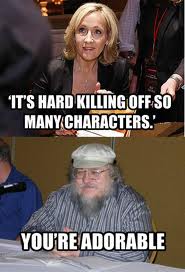
The first example of a story where no one is safe is A Song of Ice and Fire by G.R.R. Martin. One of the catch phrase used in this series of books is actually “Valar Morghulis”, which can be translated as “all men must die”. In the books (as well as in the TV show Game of Thrones that is aired on HBO since 2011), a great number of the major characters die, often brutally and unexpectedly.

The second example I have come across recently is the Starz TV show Spartacus, created by Steven S. DeKnight and Robert Tapert. In this historical drama, the writers’ motto is “Kill Them All”, which translates into the death of almost every single character, save for Spartacus himself.

So I get why killing off characters can be a useful writing device. When the reader has become invested in sympathetic characters, it is always a great emotional shock to see those beloved characters die, especially if those deaths are paired with acts of bravery and/or selflessness. For the writer, the death of a character can also be a great way to move the plot along. For example, at the beginning of the second season of Supernatural (a CW TV show), the death of the heroes’ father was a great way to get the story forward. In the Harry Potter series, the deaths of Sirius Black (in Harry Potter and the Order of the Phoenix) and Albus Dumbledore (in Harry Potter and the Half-Blood Prince) were impressive plot devices that made the young characters grow up and move forward despite their grief.

What I am questioning here, however, is the over-use of the device. In a way, G.R.R. Martin and the writers of Spartacus have painted themselves into a corner, because their readers/viewers now know that they shouldn’t invest too much in characters that are going to die anyway. Also the element of surprise is gone: when you get to Book 5 of A Song of Ice and Fire, you basically expect everyone to die. In this case, the reader/viewer feels cheated because instead of being presented with a great plot and believable tragic events, he is faced with yet another character’s death that doesn’t stir any emotion in him and harms the plot instead of moving it forward.

So what do you think? Do you read or write stories in which everybody dies?

Before wrapping up this post, a few words about my ROW80 goals:

1-      Write everyday: 5/7 days. This week I wrote every day except for Thursday and Friday when my day job took over my life.

2-      Self-edit The Last Queen: not exactly done. I have actually added a few scenes to the novel instead of editing it down. Argh.

3-      Continue writing the first draft of The Cursed King: done, but only a few hundred words.

Here is the Linky for the other ROW80 participants. How have you been doing?

A Round of Words in 80 Days – Round 3 – Check-in #1

Hello gentle reader,

My blog is four months old today! And I am very close to have 100 followers, how exciting is that?! Thanks to everyone who has supported me and this blog in the past few months. You’ve made this blogging endeavour worth it…

So it is now July and I have decided to join the awesome writing challenge that is A Round of Words in 80 Days (aka ROW80) for the second time. Created by Kait Nolan, it is “the writing challenge that knows you have a life”, or “the challenge that champions the marriage of writing and real life.” Unlike NaNoWriMo which runs for only a month, each ROW80 round runs for 80 days and the participating writers have to set themselves writing goals for that time. Each Wednesday and Sunday, we check in and let the others know how we are doing. The idea is to form writing habits that writers will hopefully continue once the challenge is over.

Thus after my JuNoWriMo debacle (during which I have learned that one cannot spend an average of 9.1 hours per day at work AND write a 50.000 words novel), I am back to doing a writing challenge that will actually fit into my crazy daily schedule.

So here are my goals for this round:

1-      Write everyday

2-      Self-edit The Last Queen

This was one of my goals for the last round and I did complete it, however since then I have heard Back from a few beta readers/agents and I have some new editing to do.

3-      Continue writing the first draft of The Cursed King

This is the second book in my DARKLANDS epic fantasy trilogy (more info here) and I really want to finish a first draft during this round.

Round Three starts on Monday, July 2nd and will end on Thursday, September 20th.

If you would like to join in this writing challenge and become a part of the ROW80 community, here are the rules:

  1. Post a goals post in which you lay out your goals for this round.
  2. Post a check-in post every Wednesday and Sunday, in which you share your progress with the other ROW80 participants.
  3. Comment on other participants’ check-in posts.

Here is the Linky for the other participants’ posts. What are your ROW80 goals for this round?

ROW80 Check-In #9 and JuNoWriMo update: On Procrastination

Hello gentle reader,

For the past two weeks I have been neglecting my fellow ROWers and instead focusing on the JuNoWriMo writing challenge. For those who don’t know what JuNoWriMo is, check out this post. Oh, and if you’re reading this because you’re looking for my awesome “Clear Your Shelf” Giveaway, you’ll need to look a little bit further: here.

 With JuNoWriMo, my goal is to write every day, even if I don’t make the 50,000-word goal. I hesitated a while before deciding to join in, for two reasons. First, I spend an average of 62 hours a week at work, which means that I only write between 30 minutes and an hour a day. Second, I am a slow writer: I cannot spill 1000 words onto a page in half an hour. So the prospect of having to write an average of 1667 words a day was quite frightening. But I still decided to do the challenge, as it is a great way to keep motivated and to interact with fellow writers.

So how have I been doing, you ask? I have been writing every single day, which I am very happy about. My word count, however, has been lower than the required average of 1667 words a day. As of today my average is 1160 words a day. But I am interacting with fellow writers and keeping motivated (sprints on Twitter are especially good for me!).

What JuNoWriMo has helped me do so far is fighting procrastination. You see, gentle reader, I am terrible when it comes to putting things off. At the beginning of the challenge, I was like this:

Then I set this image as my wall paper on my laptop:

And things got better.

So now, I just…

And it’s been working well so far.

How have you been doing with your writing challenges? Do you have to fight procrastination? How do you do it?

Here is theLinky for the other ROW80 participants…

Have a great week and happy writing!

ROW80 Check-In #8

Hello gentle reader,

I’m late for this check-in, as I have just returned from London (for those of you who don’t live in the UK, we enjoy a four-day weekend here for the Queen’s Diamond Jubilee). Also this is my last ROW80 check-in for this round, as I’m now done with my one and only goal:

self-edit my YA Fantasy novel The Last Queen.

I’m so happy I am done with this I could sing.

And now that The Last Queen is off living its own destiny, I’m now focusing on the JuNoWriMo challenge: my goal is to write every day, even if I don’t make the 50,000-word goal.

So thank you, fellow ROW80ers, this has been very formative for me.

And let’s not forget the Linky

Have a great week and happy writing!

ROW80 Check-In #7

Hello gentle reader,

this week again I’m happy to report that I have been working well toward my ROW80 goal: I’m ALMOST done self-editing my Fantasy novel THE LAST QUEEN… I hope to be completely done by Wednesday.

This week on the blog you can find out if you are like the writers depicted in the movies (here). It’s fun, try and take the test!

I also recommend you join a new meme called The Writer In You, hosted by Katie @The Fiction Diaries. Every Saturday she asks a question about our writing habits.

Finally, I wanted to share with you an infographic called How a Book is Born. It was created by the publishing house Weldon Owen and it shows “the path of a book from idea to final product”.

Here it is:

According to its author, the chart is only 74% accurate… Find out more here.

And last but not least, here is the Linky for the other ROW80 participants…

Have a great week and happy writing!

ROW80 Check-In #6 – Self-editing and dealing with repetitions

Hello gentle reader,

last week I tackled the issue of self-editing a novel (here!) and from your comments I gathered that a lot of us have the same problem: repetitions. When we write, we unconsciously repeat the same words or ideas when really, once is enough. Then, when self-editing our work, we are faced with the issue of dealing with those repetitions.

So here is a 4-step guide to help with reducing unconscious repetitions…

Step 1- Identify overused words

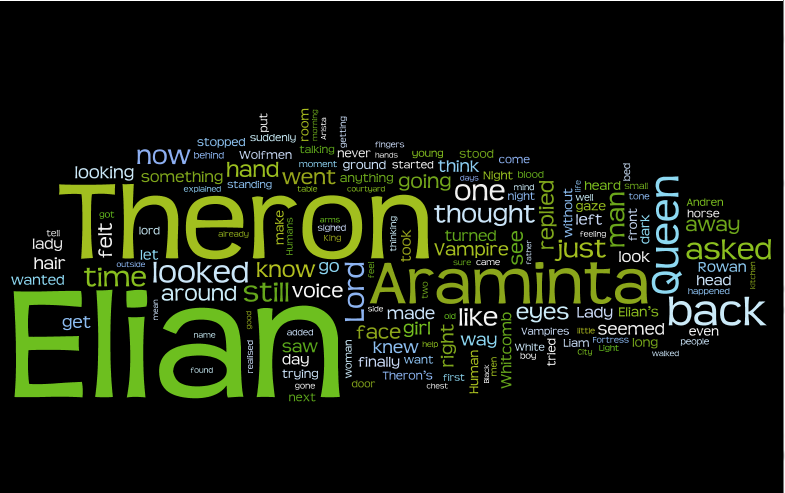
Having a fresh look at your novel or a beta-reader read your WIP is a way to identify overused words. However the best way to know which words are the most frequently used in your manuscript is to use a word cloud generator like Wordle. According to its own website, “Wordle is a toy for generating “word clouds” from text that you provide. The clouds give greater prominence to words that appear more frequently in the source text.”  So in our case, and if you paste your manuscript into Wordle, you will get a word cloud where the words that occur the most in the manuscript are the largest. The largest words in your cloud should be proper nouns.

Here is the word cloud for THE LAST QUEEN, which I’m editing during this ROW80:

See? All the biggest words are my characters’ names. If your largest words are “eyes” or “says”, you might want to have a second look at your manuscript…

Then you can…

Step 2- Identify repetitions of effects

In SELF-EDITING FOR FICTION WRITERS, Browne and King explain:

“Most writers already know to edit out places where they have literally repeated a word or phrase. But the repetition of an effect can be just as problematic. (…) Repetition can rob your writing of its power.” (pp. 175-176).

So you need to check if you have in your manuscript:

–       two sentences that give the same information,

–       two paragraphs that accomplish the same thing,

–       two characters who could be made into one without harming the plot,

–       two chapters that cover the same topic or use the same plot device.

If you do, highlight the repetitions you identify. Once you have done this, you can…

Step 3- Eliminate repetitions

Two is too many…

This is the hardest part. Because this is the time to make choices, to decide what to do with your highlighted words/sentences/paragraphs/chapters. And only you can choose whether to delete or change repetitions.

Step 4- Do a final check

To do so, repeat steps 1 and 2: your word cloud should now only have large proper nouns and you shouldn’t have the same ideas/effects repeated over and over.

That’s it for me. How are you other ROW80 writers doing?
Here is the Linky for the other check-in posts.

ROW80 Check-In #5 The art of self-editing your novel

Hello gentle reader,

6 weeks into ROW80, I am happy to announce that I have had a breakthrough in my self-editing process. As a reminder, my goal for this ROW80 is to edit my YA Fantasy manuscript The Last Queen and to have a final draft for it by the end of June.

So, up until this week I wasn’t very organized to self-edit my novel: I knew I had to cut 20K words and tidy up the whole thing, but the way I went about doing it was quite random and unsystematic.

But this week, I decided I had wasted enough time playing around with my MS and being inefficient. It was time to be professional and serious about this self-editing process.

It was time to slay some bad writing habits and come up with a shiny, edited and readable manuscript.

Today I am going to share my method to self-edit my novel, as maybe some of you, fellow would-be-published writers out there, are still struggling with this process.

Step 1: Finish the first draft of your novel. Your book has a beginning, a middle and an end. Congratulations on making it this far. Now put the manuscript away in a drawer for at least a couple of weeks and celebrate.

Step 2: Recover from celebration. then read two amazing books on the craft of writing.

How Not to Write a Novel: 200 Classic Mistakes and How to Avoid Them–A Misstep-by-Misstep Guide by Howard Mittelmark and Sandra Newman 

This one is not only a hilarious read, but it will also help you reflect on the main aspects of your novel: the plot, the characters, the setting. It is a great way to evaluate if your book has cartoonish villains, a plot so complex even you have lost track of it, or a setting so clichéd it will make any publisher nod off.

Self-editing for fiction writers by Browne and King

This second book is great for the next step of your self-evaluation: it will help you see the mistakes you have made regarding style, dialogue, points of view, beats, proportion and repetitions.

Once you have read those two books (or others like them), you can move on to…

Step 3: Know your strengths.

These you will know from experience and from the feedback of your beta readers. For example, I know that I don’t really need to amend the plot and characterization in The Last Queen. Devising a complicated plot that falls into place by the end is what I know to do best. Once you know what is great about your novel, you can focus on amending what needs to be edited, rather than wasting time fiddling with characters that are already well-written.

Step 4: Know your weaknesses.

From your readings, you should know by now what is probably not that great in your Beloved Manuscript. One of my main problems in The Last Queen is repetition. For you, it might be settings that are too detailed, lengthy paragraphs with boring content, and so on. Just know what they are. Because it is only then that you can…

Step 5: Make a checklist of what you want to edit in your novel. Edit your novel.

I love lists. They are a great tool when you self-edit as you can have yours by your computer while you read through each scene/chapter. Read each scene, and check it against your list of mistakes. If you have committed any, you edit, then move on to the next scene.

Step 6: Finish self-editing your Precious Manuscript. Celebrate some more.

Step 7: Repeat Steps 5 and 6 a few times before thinking about sending your Masterpiece to an agent.

That’s it for me. How are you other ROW80 writers doing?

Here is the Linky for the other check-in posts.

A Round of Words in 80 Days – Check-in #4

Let’s review: last week I missed my weekly check-in as I was away from home without an Internet connection. This week I’m back but I’ve had to change my goals, as what I had decided on four weeks ago is no longer attainable, given my personal circumstances (day job and other non-writing obligations).

So let’s have a look at my goals:

1-        Write the first draft of my new dystopian novel with at least 750 words per day: not anymore. I just don’t have the time. So I will probably write this first draft from time to time, but I cannot pretend I can write it every day, with a set number of words.

2-        Self-edit/revise The Last Queen so that I finally have a final draft for it: this is what I have to focus on. I need to be done with that by the end of June and so far this final draft is not ready yet. So it’s Revision, Revision, Revision for me. My manuscript needs to be 20K shorter, so I have to start making serious cuts in it. Samurai like.

That’s it for me. How are you other ROW80 writers doing?

Here is the Linky for the other check-in posts.

This week on my blog you can find:

an interview with YA writer Rebecca Maizel on writing, reading and her books.

a post on YA best-selling author Lauren DeStefano with her advice on writing a book and getting it published.

inspiring pictures!

Happy writing!