ROW80 Check-In 3 On the importance of feedback and beta readers

Welcome gentle reader,

Week 2 of ROW80 (Round 3) has ended and today I wanted to mention the importance of getting feedback on your WIP.

Because writing your novels in a vacuum can only take you so far, there is always a time when you need beta readers in order to make some progress.

“What are beta readers?” you may ask.

According to Wikipedia, “the author or writer, who can be referred to as the alpha reader, may use several beta readers prior to publication. A beta reader (…) can serve as proof-reader of spelling and grammar errors or (…) work on the “flow” of prose. In fiction, the beta reader might highlight plot holes or problems with continuity, characterisation or believability.”

So, I’ll admit it, sending off your Precious Manuscript to beta readers can be scary. No one wants to hear their writing is dreadful and their WIP should be revised from start to finish.

But you need to take that plunge in order to know what your WIP is really worth and to make the appropriate corrections BEFORE you send your Masterpiece to a dozen agents.

Indeed, it is essential to query agents with a manuscript that is in the best possible form in order to maximize your chances of success. If you follow US literary agent Sara Megibow’s #10queriesin10tweets on Twitter, you’ll notice that she receives 200 submissions A DAY. And out of those, she often comments that the writing is “poor” or “weak” or “unclear”. You don’t want to be one of those writers, do you?

So to avoid such rejection, you need to find beta readers who will critique your query/novel/short story. They will find writing issues and they will tell you about it so you can fix them.

Now, how to choose your beta readers?

Even if I’m going against the flow here, I’ll say start with your family and friends. Often, you’re told not to do this because you need critique, not praise, and your relatives tend to just tell you that you are the next big thing. Or they laugh at you. However I have found that getting some of my friends and family members to read my WIP is worth it. Firstly they are all non-writers and they are readers of published YA novels, so it is interesting for me to get their reactions on my own YA novels. One of the earliest comments I got from one of these beta readers was that my WIP was “like a real book.” It was very encouraging for me to hear that my novel could be compared to published YA books. These non-writer beta readers will tell you if your WIP is boring or impossible to understand, if they liked your characters and if they enjoyed reading your story. That’s the first step.

Then you need to find beta readers who are writers themselves. These beta readers are valuable because they will spot writing issues more easily. They will tell you about spelling and grammar errors, about plot issues etc. You can find these beta readers through a writing group, an online community or via your social media platform.

This feedback may or may not be what you want to hear? But if you listen to what your beta readers have to say, you’ll improve your chances of getting published.

Some interesting articles on beta reading:

Susan Dennard http://susandennard.com/2010/05/18/975/

Diary of a Random Fangirl http://therandomfangirl.wordpress.com/2012/04/04/writing-wednesdays-the-importance-of-beta-readers/

Bryan Thomas Schmidt http://bryanthomasschmidt.net/2011/05/21/6-tips-for-being-a-good-beta-reader/

To wrap up this post, my ROW80 progress this week:

1-     Write everyday: 5/7 days. This week I wrote every day except for Tuesday and Saturday. A special thanks to Lauren Garafalo for leading ROW80  sprints on Twitter, they really help!

2-      Self-edit The Last Queen: done. A little bit.

3-      Continue writing the first draft of The Cursed King: not done. Instead I wrote a short story.

Also, this week on my blog, you could:

–       find out how NOT to start your novel or how hook your reader from the first paragraph.

–     read an exclusive interview with YA author Kendare Blake about her writing and how she got her best-selling ghost story Anna Dressed In Blood published.

Here is the Linky for the other check-in posts. How are you other ROW80 writers doing?

A Writer in the Spotlight – Kendare Blake

This week again I was lucky enough to have a YA author give me an exclusive interview! The idea behind the “Writer in the Spotlight” feature is that published (and bestselling) authors are the best source of advice for us, would-be-published writers. Today’s interview is with the ever awesome Kendare Blake, whose YA ghost story Anna Dressed In Blood is one of my favourite books.


Author : Kendare Blake

Genre : Young Adult, Paranormal, Ghost story, Horror

Website : http://kendareblake.com/

Blog: http://kendare-blake.livejournal.com/

Twitter: http://twitter.com/KendareBlake

Books : The Anna series: Anna Dressed In Blood (2011), Girl of Nightmares (released August 7th, 2012)

                  Sleepwalk Society (2010)

                   Antigoddess (released 2013)

My interview (13/07/2012):

On writing:

Did you always know you wanted to be a writer?

Yes. Though I didn’t think of it as a practical option after I graduated from high school. I still didn’t think it was a practical option when I decided to do it after grad school. But by then I’d come to terms with the idea of being a starving artist.

When and where do you write?

I write when I have spare time. And after I’ve done everything else that could possibly need doing. (Master procrastinator!) My office is in my apartment and consists of a kitchen table, a printer, my laptop, stacks of books and sheafs of paper.

Do you ever experience writer’s block?

No! And now I must go find wood and knock on it, and pet my black cat backwards.

What do you say to people who want to be writers?

Excellent! Books books and more books. The world needs ’em.

Can you tell us a little bit about your publishing journey? (the different steps and how long it took you to be published)

I’ll tell you Anna’s story. Which was not the first book I wrote, or the first book I sold. The first book I wrote (seriously wrote, not wrote during childhood) was the first book I sold, but it took forever.

I wrote Anna in about eight months. Queried agents for about two months. Got a few requests for fulls, and some rejections. Ended up with two offers of representation, both from amazing agents. One a smaller more boutique agent, and another with the backing of a big agency. Talked with both of them. Ended up going with the smaller agency. Anna went out on submission and was out for about three months. I think. We started getting nibbles around the month and a half mark. Some rejections. Went to a few editorial boards. Wound up with two offers, so I guess you’d call that a mini-auction. I went with Mel Frain, at Tor Teen, and she’s excellent and bodacious. Anna sold in April, 2010 and pubbed in August 2011.


On “Anna Dressed In Blood”:

What made you choose to write a ghost/horror story?

I wanted to play Silent Hill but was too scared. And I missed reading Stephen King and Anne Rice. When I was in London, I’d rekindled my love of the fantastic, with Joe Hill and Angela Carter.

What is striking about your book is its voice. Did you work a lot on that or did it come to you naturally when you started writing the book?

Cas’ voice came naturally. I can’t imagine how hard it would have been if it hadn’t. He was real from the moment he hit the page. If he hadn’t been, I probably would’ve stopped.

To write this book, where did you get your inspiration from?

No idea. Anna’s name came to me first. Anna Dressed in Blood. And I thought, who’s that? Oh of course. She’s a dead girl who kills people. Hmm. Someone ought to kill her.

Cas is awesome. Anna is amazing. How did you come up with those characters?!

They sort of came up with themselves. I knew what Anna was, but not exactly who. She was a murderous ghost. A real badass. That side was easy. Her human part didn’t reveal until later. I knew Cas was a ghost hunter, with a knife. I knew he’d go after her, and that he was a loner. That’s about it.

What type of music did you listen to when you wrote this book?

I didn’t! I can’t write and listen to music that often. I usually end up just jamming, and nothing gets done.

What are you working on now?

Right now is that wonderful phase of juggle city! I’m halfway through the second book in my new series and the first one comes back ready for edits. So I’m putting aside the second this week to polish up the first.

The new series kicks off with ANTIGODDESS next August. It’s Greek gods in the modern world. Athena and Hermes and Odysseus and Cassandra. Dying gods at war and the teens who get caught in their mess. Very, Terminator. Or Terminator 2. Maybe just very Sarah Connor.


Reading advice:

Which authors inspire you now? Any YA books you would recommend?

Right now I’m halfway through WE HAVE ALWAYS LIVED IN THE CASTLE by Shirley Jackson. Not YA exactly but holy shit. How have I not read this before? It’s a flipping masterpiece. Ominous and so beautiful. On the YA side I’m consistently inspired by the short stories of Holly Black, and by loads of others. I’d recommend reading her collection THE POISON EATERS and also…well, it depends what you’re in the mood for. Suzanne Young’s A NEED SO BEAUTIFUL is amazing. The sequel, A WANT SO WICKED is out now. Kristen Simmons’ ARTICLE 5 is harrowing. Deb Caletti’s STAY from last year…so many more!

Thanks for the interview Kendare!

Thank you for having me by the blog! And for the fun interview questions 🙂

Girl of Nightmares will be out on August 7th, 2012. Buy it on Amazon here.

Openings : how not to start your novel

A few tips I picked up along the way on how not to mess up your novel from the start… or on how to hook your reader with your first paragraph.

What you shouldn’t start your novel with:

–          The weather report: “It was warm and cloudy with a chance of scattered showers on the day Harry and Sally met.” Just start with Harry meeting Sally and include the weather later.

–          A dream: “… And then Sally woke up.” Let us start with something actually happening, shall we?

–          Your main character waking up and proceeding to having a normal day: “It was a day like any other day and Sally woke up, got out of bed, hopped in the shower and got dressed like she did every day. Little did she know that it was the day her life was going to change…” Just fast forward to the actual life-changing event.

–          A description of your novel’s setting: “Once upon a time, in a land where there were deep forests, green pastures and mirror-like lakes…” Action must come first, THEN the setting and world-building.

–          A page-long dialogue: “You’re joking”, Sally said. “No, I’m not,” Harry replied. “It is true, I swear. Just ask Marny.” “I don’t believe you,” Sally retorted. “I wish you did,” Harry insisted.” Meanwhile, the reader has no clue what’s going on and doesn’t really care.

–          Your main character running: “Sally was running through the woods and she could hear the beast not far behind her.” Sure, it is an in medias res situation. But it has been done so many times before and you can be much more original.

–          A sex scene: “Sally screamed with pleasure and collapsed on Harry’s muscular body.” Unless you’re writing erotica or romance, this is to be avoided on your first page.

–          A prologue that gives away the ending: “Sally was running through the woods, knowing she had no way of escaping Harry’s murderous intent. Yet when they had met six months before, she would have never guessed their relationship would end like this.” The fact that Twilight has such a prologue doesn’t mean you have to do it too.

What you should start your novel with:

–          A catchy first sentence : “Most people would probably call me a ghost. I am, after all, dead. But it wasn’t so long ago I was alive, you see. I was just 18. I had my whole life in front of me.” Remember Me by Christopher Pike.

–          An In Medias Res (“in the middle of things”) situation: “There was a hand in the darkness, and it held a knife.” The Graveyard Book by Neil Gaiman.

What you could start your novel with:

–          Your main character waking up and everything is different: “When I wake up, the other side of the bed is cold.”  The Hunger Games by Suzanne Collins.

–          A meaningful prologue: “A mile above Oz, the Witch balanced on the wind’s foreward edge, as if she were a green fleck of the land itself, flung up and sent wheeling away by the turbulent air.” Wicked: The Life and Times of the Wicked Witch of the West by Gregory Maguire

–          One sentence from a dialogue followed by some narration: “I SEE …” said the vampire thoughtfully, and slowly he walked across the room towards the window.” Interview with the Vampire by Anne Rice.

So how does your novel start? Have you avoided all the above pitfalls ? Do you think these ‘rules’ for opening are worth following? Leave me a comment, I’d love to hear your thoughts!

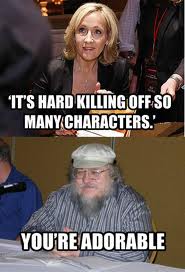
Valar Morghulis : On killing your characters

Hello gentle reader,

for this second ROW80 check-in, I thought I would tackle the issue of killing characters in novels. Let’s say you’ve created a number of interesting and believable characters in your WIP. Is killing off one or all of them going to help or harm your novel?

Over the past few months I have had to consider this question for two reasons:

–          one of the main characters in my epic fantasy novel The Last Queen dies at the end of the book and some of my beta readers have protested against such a death.

–          I have come across several serial stories where killing off characters was an over-used writing device and it made me wonder when killing your characters actually damages your story rather than makes it go forward.

I am not talking here about the horror genre, where killing off all the characters one by one is an expected writing device. I am talking about the other genres, especially Fantasy and Historical Fiction.

The first example of a story where no one is safe is A Song of Ice and Fire by G.R.R. Martin. One of the catch phrase used in this series of books is actually “Valar Morghulis”, which can be translated as “all men must die”. In the books (as well as in the TV show Game of Thrones that is aired on HBO since 2011), a great number of the major characters die, often brutally and unexpectedly.

The second example I have come across recently is the Starz TV show Spartacus, created by Steven S. DeKnight and Robert Tapert. In this historical drama, the writers’ motto is “Kill Them All”, which translates into the death of almost every single character, save for Spartacus himself.

So I get why killing off characters can be a useful writing device. When the reader has become invested in sympathetic characters, it is always a great emotional shock to see those beloved characters die, especially if those deaths are paired with acts of bravery and/or selflessness. For the writer, the death of a character can also be a great way to move the plot along. For example, at the beginning of the second season of Supernatural (a CW TV show), the death of the heroes’ father was a great way to get the story forward. In the Harry Potter series, the deaths of Sirius Black (in Harry Potter and the Order of the Phoenix) and Albus Dumbledore (in Harry Potter and the Half-Blood Prince) were impressive plot devices that made the young characters grow up and move forward despite their grief.

What I am questioning here, however, is the over-use of the device. In a way, G.R.R. Martin and the writers of Spartacus have painted themselves into a corner, because their readers/viewers now know that they shouldn’t invest too much in characters that are going to die anyway. Also the element of surprise is gone: when you get to Book 5 of A Song of Ice and Fire, you basically expect everyone to die. In this case, the reader/viewer feels cheated because instead of being presented with a great plot and believable tragic events, he is faced with yet another character’s death that doesn’t stir any emotion in him and harms the plot instead of moving it forward.

So what do you think? Do you read or write stories in which everybody dies?

Before wrapping up this post, a few words about my ROW80 goals:

1-      Write everyday: 5/7 days. This week I wrote every day except for Thursday and Friday when my day job took over my life.

2-      Self-edit The Last Queen: not exactly done. I have actually added a few scenes to the novel instead of editing it down. Argh.

3-      Continue writing the first draft of The Cursed King: done, but only a few hundred words.

Here is the Linky for the other ROW80 participants. How have you been doing?

The Lucky 7 Meme

This week I was tagged in the Lucky 7 meme by the lovely Belle DiMonté.

Here are the rules:

1) Go to page 7 or 77 from your current WIP (work in progress)

2) Go to line 7

3) Copy down the next 7 lines–sentences or paragraphs–and post them as they’re written. No cheating!

4) Tag 7 authors and let them know

So here is an excerpt from The Last Queen, which I am currently editing:

She pushed a cup toward him and raised her own.

“To the God of Light!”

Then she drank her wine. Elian didn’t even move to take his cup. In his experience, if you kept very still and very quiet for a long time, people just gave up on trying to get anything out of you. But the girl wasn’t giving up so easily.

She poured herself more wine and went on.

“Like, for example, have you seen real Vampires in your life? I’m sure you have!”

And now the next 7 tagged writers are…

Raewyn Hewitt

Sydney Aaliyah

Juliana Haygert

Yesenia Vargas

Amanda Fanger 

Morgan Hyde

Rebecca Berto

Thanks to Belle for tagging me !

A Round of Words in 80 Days – Round 3 – Check-in #1

Hello gentle reader,

My blog is four months old today! And I am very close to have 100 followers, how exciting is that?! Thanks to everyone who has supported me and this blog in the past few months. You’ve made this blogging endeavour worth it…

So it is now July and I have decided to join the awesome writing challenge that is A Round of Words in 80 Days (aka ROW80) for the second time. Created by Kait Nolan, it is “the writing challenge that knows you have a life”, or “the challenge that champions the marriage of writing and real life.” Unlike NaNoWriMo which runs for only a month, each ROW80 round runs for 80 days and the participating writers have to set themselves writing goals for that time. Each Wednesday and Sunday, we check in and let the others know how we are doing. The idea is to form writing habits that writers will hopefully continue once the challenge is over.

Thus after my JuNoWriMo debacle (during which I have learned that one cannot spend an average of 9.1 hours per day at work AND write a 50.000 words novel), I am back to doing a writing challenge that will actually fit into my crazy daily schedule.

So here are my goals for this round:

1-      Write everyday

2-      Self-edit The Last Queen

This was one of my goals for the last round and I did complete it, however since then I have heard Back from a few beta readers/agents and I have some new editing to do.

3-      Continue writing the first draft of The Cursed King

This is the second book in my DARKLANDS epic fantasy trilogy (more info here) and I really want to finish a first draft during this round.

Round Three starts on Monday, July 2nd and will end on Thursday, September 20th.

If you would like to join in this writing challenge and become a part of the ROW80 community, here are the rules:

  1. Post a goals post in which you lay out your goals for this round.
  2. Post a check-in post every Wednesday and Sunday, in which you share your progress with the other ROW80 participants.
  3. Comment on other participants’ check-in posts.

Here is the Linky for the other participants’ posts. What are your ROW80 goals for this round?

The Writer In You Blog Hop – 3

The Writer In You is a blog hop hosted by Katie at The Fiction Diaries. In her own words, “this is a blog hop for all aspiring writers out there. It is a chance to meet other writers and share tips, writing, and experiences, all while gaining new followers for your lovely blog…” Every Saturday, Katie asks a question that we have to answer.

This week’s question is: What is your favorite classic novel and is there anything in particular you take from it that you hope to see in your own writing?

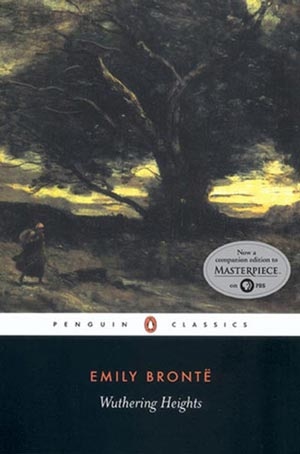
My favourite classic novel is undoubtedly Wuthering Heights by Emily Brontë. Published in 1847, this book is considered a masterpiece of English literature. It is famous for its doomed love between Catherine Earnshaw and Heathcliff, which is indeed the most passionate and fascinating love story I have ever read.

But what I find incredibly inspiring in this novel is how DARING it is. Not only does the novel have a complex narrative structure (hello multiple narrators and mise en abyme) and it depicts an amazing setting, but it also includes incredibly violent scenes, bold topics and dialogues in Yorshire dialect.

Wuthering Heights’ writing is actually so bold and original that it has often been suggested that Emily Brontë, a shy clergyman’s daughter who lived in the middle of nowhere, couldn’t possibly have written such a book. Yet she did. It’s called the power of imagination.

And I wish my books were half as daring as Wuthering Heights.

“If all else perished, and he remained, I should still continue to be; and if all else remained, and he were annihilated, the universe would turn to a mighty stranger.”

For everything there is to know about Wuthering Heights, visit: http://www.wuthering-heights.co.uk/index.htm

What about you? What is your favorite classic novel? Join the fun here and happy writing!

A Writer in the Spotlight – Ada Adams

This week again I was lucky enough to have a YA author give me an exclusive interview! The idea behind the “Writer in the Spotlight” feature is that published (and bestselling) authors are the best source of advice for us, would-be-published writers. Today’s interview is with Ada Adams, a debut author who also happens to be successfully self-published.

Author : Ada Adams

Genre : Young Adult, Science Fiction & Fantasy

Location: Toronto, Canada

Website : http://www.revampedbook.com

Twitter: Ada_Adams

Books : ReVamped (2012)

My interview (27/06/2012):

1. Did you always know you wanted to be a writer?

I’ve always loved to create stories. I was the type of child that could entertain myself for hours, simply by digging deep into my imagination. At the age of five, I became a full-time chapter book reader and started writing my own stories. My mom still reads them, although I don’t think that anyone else would be very interested in my early writing! When I was twelve or thirteen, I took a break from writing stories and began writing synopses—just synopses—for some reason! That was my period of contemporary mysteries, friendship stories, and cute boy characters with piercing blue eyes. High school creative writing courses solidified my passion for the craft, and I never looked back. I love that writing is so personal and creative; it’s a different process for every writer.

2. When and where do you write?

When I’m working on a project, I usually write full-time from around 8 a.m. to 4:00 p.m. (with an hour or so lost due to fun online distractions). When I’m trying to finish a project (especially in the editing stages), I write all the time. Sometimes, I forget to eat and sleep. Most of my projects have been written in my office space, but ever since I moved to a new place this year, I find myself writing everywhere except my new office. I think it still needs some breaking-in!

3. Do you ever experience writer’s block?

I most certainly do. It usually doesn’t center around the overall plot of a story, but rather a small scene or a minor event. I find that swimming or running are my best “writer’s block” remedies.

4. What do you say to people who want to be writers?

I say “go for it”! I think writing is such a personal journey for each individual. It’s often very hard to give advice on the process, because what works for one writer may not work for another. My biggest piece of advice would be to love what you do, keep writing, and read. I love learning about new writers and their projects. I think it’s wonderful that our world is filled with so many diverse writers and readers.

5. Is it better to outline and plot your novel or “go with the flow”?

Once again, this is probably very different for each writer. Personally, I need to work with an outline (especially for a novel). I like lists and plans, so in order for the story to be the best it can be, I make sure to plot it out. However, while outlines are important, it’s also important not to be too rigid with them. I’ve often steered away from the outlined path simply because of a character’s action or motivation. I enjoy when my characters surprise me. They often make the story a lot better than originally planned!

6. Do you set goals for yourself as you write?

I outline the entire piece in “words per day” before I embark on a new writing project. Often, my goals are somewhat unrealistic; however they do help keep me on track.


On “ReVamped”:

7. To write this book, where did you get your inspiration from?

The main inspiration for this series came from my observation of the fact that our society is currently head-over-heels in love with vampires! This fascination has always been present, but it has grown stronger over the past decade. I wanted to explore what would happen if, because of our love for them, vampires decided to “come out of the coffin”.

I love that our world is filled with so many great books, films, and shows about strong, dark, sexy vampires, but I wanted to take a different approach to the genre. I wanted to put a humorous spin on vampires, and explore the world of misfits—the vampires who need a lot of “revamping” to even become decent human beings, let alone great vamps!

Originally, “ReVamped” was a TV show script. I was inspired by some great comedic shows and web series about life’s underdogs. However, the budget for shooting the project in the quality that I had envisioned was simply incomprehensible, so I let it sit on my computer for a couple of months. Soon, the characters began to invade my dreams—and even waking moments—and I simply knew that I would have to finish their story one way or another. Hence, “ReVamped” the novel was born!

8. Dawn: How did you come up with this character?

In most YA vampire novels, it’s somewhat rare for the main character to actually be a vampire. However, I really wanted Dawn to be unique. I created her to be strong, adventurous, and intelligent, yet to also have some quirks and weaknesses. I’m not a big fan of “perfect” characters, so I enjoy seeing Dawn make mistakes or be unsure of herself at times. (Hmm…I just divulged that I like to watch my character struggle? Does that make me a mean writer?)  Weaknesses also provide the character with opportunity for growth as the series develops. As well, Dawn is not the type of girl that “needs” a man in her life, so I didn’t want to rush any kind of romantic relationships when it came to the guys in the story. Even in fantastical stories, I think it’s important to have strong female role models that girls can admire or relate to.

Many readers have asked me if “I am Dawn”, and to that I have to say that all of my characters are completely fictional. Sure, I injected Dawn with my love for martial arts and adventure, but I would never be able to objectively write about a character if I saw them as myself or they reminded me of someone I knew. Dawn is 100% Dawn (despite “you know what”)). 😉

9. What type of music did you listen to when you wrote this book?

To be perfectly honest, I’m the type of writer that requires silence while writing. I get very distracted when I listen to music (especially songs with words in them) I did get inspired by certain songs (before and after the process). Florence and the Machine’s “Shake It Out” comes to mind when I think of Dawn’s journey (especially in the third book).

10. What are you working on now? Is “ReAwakened” finished or still a work in progress?

I’m currently working on the rest of the “Angel Creek” series, as well as a few other personal projects. My main goal is to finish Dawn’s story within the next year. “ReAwakened” is almost finished. It’s currently being subjected to a lot of rewrites and edits—my least favourite part of the writing process (though often the most important).

Reading advice:
11. Which authors inspire you now? Any YA books you would recommend?

Overall, I’m a very diverse reader. I love the fact that there are so many talented YA authors out there (I still have many to explore)! I usually enjoy books with strong heroines like Katniss from “The Hunger Games”, and I’ve always been in admiration of J.K. Rowling’s “Harry Potter” series. Whether you’ve enjoyed the story or not, there is no denying that Ms. Rowling is immensely talented and extremely creative! “Harry Potter” was a book that instilled a passion for reading in so many young readers. Is there any greater accomplishment for an author?

On self-publishing:

12. Why did you choose to self-publish “ReVamped” and would you recommend self-publishing to would-be-published writers out there?

One word: vampires. It’s a genre that’s somewhat oversaturated at the moment, so I weighed my options of spending the next few years trying to pitch a debut vampire novel, or sharing it with my readers a little sooner. I really wanted to tell Dawn’s story, so I did a lot of research on self-publishing and decided that for this particular book, it was the way to go. However, I have many other projects that I would never allow to see the light of day unless they take the traditional publishing route. Self-publishing is not easy, especially since I am a perfectionist and strive to create the best product possible.

There’s a lot to say for the importance of agents and publishers in the industry. I believe that traditional publishers can aid in ensuring that the author’s best work is presented to readers. It’s not easy to pursue a self-published route, but if you choose to do so, my advice would be to make certain that your work and presentation is professional, your editing is good, and your pricing is fair.

I know that there is much discussion amongst the writing and reading communities when it comes to traditional vs. self-publishing, but personally, I’m not on either side of the spectrum. There are some amazing indie authors out there, just like there are some awesome traditionally published authors. Every single writer’s (and even novel’s) journey is different! As long as you love what you do and believe in your work, you’re already on the right track!

Thank you again for doing this!

Thank you so much for the wonderful interview questions, EM! I had a blast!


ReVamped is out now and you can buy it on Amazon.

The Fantasy Novelist’s Exam by David J. Parker

So I didn’t write this post. This post was first published by David J. Parker (with additional material by Samuel Stoddard) on this website. Since it is awesome, I have decided to share it with you. Visit the RinkWorks Production website for more information.

So here goes…

“Ever since J.R.R. Tolkien and C.S. Lewis created the worlds of Middle Earth and Narnia, it seems like every windbag off the street thinks he can write great, original fantasy, too. The problem is that most of this “great, original fantasy” is actually poor, derivative fantasy. Frankly, we’re sick of it, so we’ve compiled a list of rip-off tip-offs in the form of an exam. We think anybody considering writing a fantasy novel should be required to take this exam first. Answering “yes” to any one question results in failure and means that the prospective novel should be abandoned at once.”

David J. Parker.

The Exam

  1. Does nothing happen in the first fifty pages?
  2. Is your main character a young farmhand with mysterious parentage?
  3. Is your main character the heir to the throne but doesn’t know it?
  4. Is your story about a young character who comes of age, gains great power, and defeats the supreme badguy?
  5. Is your story about a quest for a magical artifact that will save the world?
  6. How about one that will destroy it?
  7. Does your story revolve around an ancient prophecy about “The One” who will save the world and everybody and all the forces of good?
  8. Does your novel contain a character whose sole purpose is to show up at random plot points and dispense information?
  9. Does your novel contain a character that is really a god in disguise?
  10. Is the evil supreme badguy secretly the father of your main character?
  11. Is the king of your world a kindly king duped by an evil magician?
  12. Does “a forgetful wizard” describe any of the characters in your novel?
  13. How about “a powerful but slow and kind-hearted warrior”?
  14. How about “a wise, mystical sage who refuses to give away plot details for his own personal, mysterious reasons”?
  15. Do the female characters in your novel spend a lot of time worrying about how they look, especially when the male main character is around?
  16. Do any of your female characters exist solely to be captured and rescued?
  17. Do any of your female characters exist solely to embody feminist ideals?
  18. Would “a clumsy cooking wench more comfortable with a frying pan than a sword” aptly describe any of your female characters?
  19. Would “a fearless warrioress more comfortable with a sword than a frying pan” aptly describe any of your female characters?
  20. Is any character in your novel best described as “a dour dwarf”?
  21. How about “a half-elf torn between his human and elven heritage”?
  22. Did you make the elves and the dwarves great friends, just to be different?
  23. Does everybody under four feet tall exist solely for comic relief?
  24. Do you think that the only two uses for ships are fishing and piracy?
  25. Do you not know when the hay baler was invented?
  26. Did you draw a map for your novel which includes places named things like “The Blasted Lands” or “The Forest of Fear” or “The Desert of Desolation” or absolutely anything “of Doom”?
  27. Does your novel contain a prologue that is impossible to understand until you’ve read the entire book, if even then?
  28. Is this the first book in a planned trilogy?
  29. How about a quintet or a decalogue?
  30. Is your novel thicker than a New York City phone book?
  31. Did absolutely nothing happen in the previous book you wrote, yet you figure you’re still many sequels away from finishing your “story”?
  32. Are you writing prequels to your as-yet-unfinished series of books?
  33. Is your name Robert Jordan and you lied like a dog to get this far?
  34. Is your novel based on the adventures of your role-playing group?
  35. Does your novel contain characters transported from the real world to a fantasy realm?
  36. Do any of your main characters have apostrophes or dashes in their names?
  37. Do any of your main characters have names longer than three syllables?
  38. Do you see nothing wrong with having two characters from the same small isolated village being named “Tim Umber” and “Belthusalanthalus al’Grinsok”?
  39. Does your novel contain orcs, elves, dwarves, or halflings?
  40. How about “orken” or “dwerrows”?
  41. Do you have a race prefixed by “half-“?
  42. At any point in your novel, do the main characters take a shortcut through ancient dwarven mines?
  43. Do you write your battle scenes by playing them out in your favorite RPG?
  44. Have you done up game statistics for all of your main characters in your favorite RPG?
  45. Are you writing a work-for-hire for Wizards of the Coast?
  46. Do inns in your book exist solely so your main characters can have brawls?
  47. Do you think you know how feudalism worked but really don’t?
  48. Do your characters spend an inordinate amount of time journeying from place to place?
  49. Could one of your main characters tell the other characters something that would really help them in their quest but refuses to do so just so it won’t break the plot?
  50. Do any of the magic users in your novel cast spells easily identifiable as “fireball” or “lightning bolt”?
  51. Do you ever use the term “mana” in your novel?
  52. Do you ever use the term “plate mail” in your novel?
  53. Heaven help you, do you ever use the term “hit points” in your novel?
  54. Do you not realize how much gold actually weighs?
  55. Do you think horses can gallop all day long without rest?
  56. Does anybody in your novel fight for two hours straight in full plate armor, then ride a horse for four hours, then delicately make love to a willing barmaid all in the same day?
  57. Does your main character have a magic axe, hammer, spear, or other weapon that returns to him when he throws it?
  58. Does anybody in your novel ever stab anybody with a scimitar?
  59. Does anybody in your novel stab anybody straight through plate armor?
  60. Do you think swords weigh ten pounds or more? [info]
  61. Does your hero fall in love with an unattainable woman, whom he later attains?
  62. Does a large portion of the humor in your novel consist of puns?
  63. Is your hero able to withstand multiple blows from the fantasy equivalent of a ten pound sledge but is still threatened by a small woman with a dagger?
  64. Do you really think it frequently takes more than one arrow in the chest to kill a man?
  65. Do you not realize it takes hours to make a good stew, making it a poor choice for an “on the road” meal?
  66. Do you have nomadic barbarians living on the tundra and consuming barrels and barrels of mead?
  67. Do you think that “mead” is just a fancy name for “beer”?
  68. Does your story involve a number of different races, each of which has exactly one country, one ruler, and one religion?
  69. Is the best organized and most numerous group of people in your world the thieves’ guild?
  70. Does your main villain punish insignificant mistakes with death?
  71. Is your story about a crack team of warriors that take along a bard who is useless in a fight, though he plays a mean lute?
  72. Is “common” the official language of your world?
  73. Is the countryside in your novel littered with tombs and gravesites filled with ancient magical loot that nobody thought to steal centuries before?
  74. Is your book basically a rip-off of The Lord of the Rings?
  75. Read that question again and answer truthfully.

Hoping you enjoyed!

Feel free to leave a comment below…

ROW80 Check-In #9 and JuNoWriMo update: On Procrastination

Hello gentle reader,

For the past two weeks I have been neglecting my fellow ROWers and instead focusing on the JuNoWriMo writing challenge. For those who don’t know what JuNoWriMo is, check out this post. Oh, and if you’re reading this because you’re looking for my awesome “Clear Your Shelf” Giveaway, you’ll need to look a little bit further: here.

 With JuNoWriMo, my goal is to write every day, even if I don’t make the 50,000-word goal. I hesitated a while before deciding to join in, for two reasons. First, I spend an average of 62 hours a week at work, which means that I only write between 30 minutes and an hour a day. Second, I am a slow writer: I cannot spill 1000 words onto a page in half an hour. So the prospect of having to write an average of 1667 words a day was quite frightening. But I still decided to do the challenge, as it is a great way to keep motivated and to interact with fellow writers.

So how have I been doing, you ask? I have been writing every single day, which I am very happy about. My word count, however, has been lower than the required average of 1667 words a day. As of today my average is 1160 words a day. But I am interacting with fellow writers and keeping motivated (sprints on Twitter are especially good for me!).

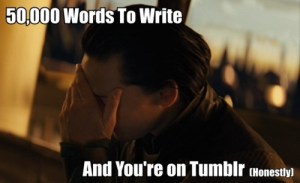
What JuNoWriMo has helped me do so far is fighting procrastination. You see, gentle reader, I am terrible when it comes to putting things off. At the beginning of the challenge, I was like this:

Then I set this image as my wall paper on my laptop:

And things got better.

So now, I just…

And it’s been working well so far.

How have you been doing with your writing challenges? Do you have to fight procrastination? How do you do it?

Here is theLinky for the other ROW80 participants…

Have a great week and happy writing!