ROW80 Check-In 10: Rae Carson’s success story

Hello gentle reader and fellow writers,

This week I have been hearing a lot about a British teenage writer who got a 6-figure book deal in less than 2 years. As dreamlike as these publishing stories are, I wanted to highlight another author’s story today.

Rae Carson is a YA High Fantasy author whose first book, The Girl of Fire and Thorns, came out in 2011. It was a nominee for the Andre Norton Award and the William C. Morris YA Debut Award. It was also an ALA (American Library Association) Top 10 Best Fiction for Young Adults honoree in 2012. The second book in The Fire and Thorns Trilogy, entitled The Crown of Embers, is coming out on September 18th 2012. Her third book, The Bitter Kingdom, will be published in 2013. In June 2012, she sold a new romantic fantasy trilogy set during the American gold rush to HarperCollins’s Greenwillow Books.


Rae’s journey into publishing is interesting because it was slow. She became serious about writing back in 2004, and it took her 7 years to get a book published. Along the way she sold a couple of short stories, wrote a first book which is still in her drawer, then in 2005 she wrote the first draft of The Girl of Fire and Thorns. She got an agent, and never sold the novel to a publisher. So she revised it and decided to go with another agent, who managed to sell the book within 24 hours. It took then another couple of years to have the book sitting on bookshelves in bookstores.

Here is what Rae says on her website:

I graduated college with a degree in Social Science–which qualified me to flip burgers–and a mound of education debt. I still didn’t know what I wanted to do when I grew up.

Well, that’s not true. I did know. I wanted to be a novelist. But that just wasn’t practical, and I had to come up with something else. I had to have a Plan B. So I tried bank tellering, secretarial work, customer service, inside sales, substitute teaching, data entry, logistics, and even machine shop-ing. I didn’t enjoy any of it.

In 2004, after quitting a very high paying job in a very toxic atmosphere, I decided to get serious about writing. It was the only thing I kept coming back to, the one thing that had held my interest over time and distance and lots of life change. So I joined the Online Writing Workshop for Science Fiction, Fantasy, and Horror where I met my future best friends, my future husband, and my calling.

I spent the next few years happily writing awful stuff. During this time, I got to know C.C. Finlay online, and after going on three real-life dates, I moved from California to Ohio to marry him. The writing became a lot less awful, and eventually I sold my first novel to Greenwillow/HarperCollins.

Hindsight is easy, I know, and writing about the awkwardness of adolescence is way easier than living it. But I can say unequivocally that although growing up is hard, it’s totally worth it. It’s possible to become your better self. And dreams, no matter how impractical, are made to be pursued.”

So do you find this story inspirational? Do you believe the traditional route to publishing is too slow? Or does it guarantee great books from great authors for readers? I’d love to read your thoughts in the comment section!

You can find Rae Carson on Twitter and Facebook.

To write this post, I have used:

http://www.locusmag.com/Perspectives/2012/07/rae-carson-amulet-of-power/

http://shelf-life.ew.com/2012/09/13/fire-and-thorns-author-rae-carson/

My ROW80 update for this week:

this week I have tried writing a short story AND revising my WIP The Last Queen. The reuslt is that I have a unfinished short story and I’m late in my revisions. So for the last week of this round, I need to focus on revisions.

How are you other ROWers doing? Here is the Linky to support each other!
ROW80 Check-In 9 – Prologues: How and why to write one

Hello gentle readers and fellow writers,

Last week I came across an interesting post on the MythicScribes forum. It is a great forum for fantasy writers and a member called Lunaairis posted his thoughts on prologues on August 17th 2012.

Usually, writers are advised to avoid including prologues at the beginning of their novels. Prologues should be banned because they most likely are 1) unnecessary lengthy narrative of back story, 2) boring scene-setting that can be cut without harming the plot, 3) information that should be your chapter One, 4) something that readers don’t read anyway.

However many published Epic Fantasy books do start with a prologue and Lunaairis explains in his post when and how this is acceptable:

“I was looking at a post about prologues and I couldn’t help but think that there seems to be something wrong with people’s reactions to them. I for one like prologues as they can set the tone for the rest of the story; When they are prologues and not just masses of text. After reading Farlander (by Col Buchanan) I have realized what makes a prologue good, and why more fantasy stories need them.

1) A prologue should be like the story you will tell but in miniature, it should be no longer then your longest chapter and should never be split into parts (I’ve seen this done and it’s just horrendous). That said you should always leave the prologue to be the last thing you write. A prologue is so much like a door hinge I can’t even begin to explain. It is best used with the idea to gather readers; it’s a chapter the average man/woman or child can read at a book store to get a feel for the authors writing without going into the main story. It is what an author should use for getting the reader from the real world to their fictional world. Again like a door hinge it keeps the book open for the public eye to grab a glimpse.

2) The author can also use the prologue to slip in information that the other characters in the novel might already know (if it is important to the story). You wouldn’t want to write a chapter about a city falling to pieces, only for it to have no purpose for the rest of the story, waste-of-space much? (…) Don’t allow prologues to become information dumps, remember you are trying to get the average reader into your story, don’t bombard them with names that won’t or can’t be explained till 2-3 chapters in.

3) Prologues, after keeping in mind that they should not be long, they should also not be short. A prologue consisting of 1-4 paragraphs is rather useless; all the information presented could be bleed into the speech of some of the characters. Removing the need for the prologue all together. If there are only 1-4 paragraphs it’s likely that you just wrote an information dump and should delete it anyways.

4) There should be a story going on in your prologue, a beginning and an end. Introduce a key character in your story, Maybe a villain? The main character? A magic object? Something that has reason to exist, and has wants and needs. Present them a challenge; it could be a rival, a theft (the theft of a person’s life, an object, a person or a way of thinking) or maybe the end of a cycle. (…) Remember when coming up with the challenge, it may be a good idea to take the main problem of you fiction but show it on a miniature scale. If your story is about racism show a glimpse of the racism here.

5) Now show off the character or object’s skills by somehow getting them though the situation. This is a great way to get your reader interested in the character or object they are going to follow for the rest of the book. It’s time to show their talents, as this character or object may not be the only main character or object of the novel but is the one that pulls the story along, and likely won’t be showing up again for a few chapters.

6) Never talk history in the prologue; write as it happens. Do you remember sitting in those boring history classes with your unexciting history teacher? Thank god I loved history and never had a crappy history teacher. But I know other people who have and I also know they don’t like to read about it in their fiction, so keep it out of there! There is a time and a place to talk about the last great war between the Jubjubwicks and the Didolgigs but the prologue is not the place to be talking politics from a second source.”

So what do you think? Do you agree with Lunaairis? Have you included a prologue in your novel? If yes, what is it like? Or are you against prologues? Let me know in the comment section!

Finally, my update: I have had a good writing week after a very lazy summer on the writing front. I haven’t worked on my WIP, but I have written a short story, worked on my query letter and devised a new editing plan for my WIP. Next week I’m planning on diving back into editing…

How are you fellow ROWers doing?  Here is the Linky to the list of participants.

Happy writing!

ROW Check-In 8: Elizabeth May on Writerly Misconceptions

Hello gentle reader,

so I had a tough week. I was jet-lagged and I was having doubts about this whole “let’s get my book published” thing. So I didn’t write. Instead, I read great books and decided to postpone my writing until next week. And I found a post by debut author Elizabeth May. She posted it her blog on November 22d, 2011. Since then she has sold her YA steampunk novel THE FALCONER and it will be released in May 2013.

Here is her post:

Writerly Misconceptions: YES, YES, YOU DO WORK

Basically, I’ve come to understand that aside from the other things I have to do (that dissertation to finish, that photography business to run, that teaching anthropology thing I do), I have to write sometime.

Have to.  Because, while it might have been a hobby before, writing is now one of my jobs.  I have a trilogy to plan.  A sequel I should probably be writing as I type up this blog…  I am doing things!  Important things!  My heroine is a mess and I have to FIX HER.

So when I take a day and sit on my ass in front of the computer for hours, that’s not me being lazy.  That’s me bringing home the bacon.

The other day I asked Mr. May to do some task that I really can’t recall right now because I’m only on my third cup of coffee.

His response?  ”Wait, weren’t you home all day?”

Subtext?  ”You totally could have done this thing because while I was out working, you were sitting at home.”

It’s a totally innocent comment.  He’s right.  I was home all day.  I made two pots of coffee, clicked around on mah laptop, answered a few business e-mails, worked a bit on my dissertation write up that my supervisor is demanding — and oh yeah! I wrote some of that sequel.

Now, before anyone judges Mr. May (remember that I love him and he is not a writer), he totally didn’t mean this to sound dismissive of my work.  He is voicing a very common misconception about writers.  That writing a book is easy work* and that because most of us work from home, we are ”lucky” not to have to “go to work.”

Basically, that we are less busy because writing is dependent upon the rules and hours authors set for themselves.  If we all had offices away from the home, perhaps this misconception wouldn’t exist.  But because we prefer comfortable spaces (homes or coffee shops or cafes, or my favourite place of all, the couch) it’s perceived as, essentially, laziness.  Because I could be cleaning instead of typing.  I could be doing something active.  I could be going out to run errands.  Instead, I’m being sedentary.**  Some people believe writing is not a “real job” for all of these reasons.

Because this is my significant other, I had to set this straight.  I said, “Assume that whenever I’m staying home for the day, it is my designated ‘work on book’ day. It is not my ‘clean ALL THE THINGS’ day.”

And maybe, if I finish a chapter and feel like cleaning, I will clean.  But not before!

Mr. May, of course, apologized.  Because when people make comments like this, they don’t generally realize they’re speaking from this socially engrained idea that “work” equals “being active,” or that a “real job” requires “leaving the nest, staying out from 9-5.”***

So I’m clarifying this right here, right now.  Writing is work.  Writing is a job.  Writing is not for lazy people.  We don’t write because it’s easy.  That is not why we sit in front of a laptop or a blank sheet of paper for hours.  That is not why we spend years writing practice books that no one will ever read.  That is not why we spend all that time querying and getting rejections.  And that is certainly not why we write book after book.

Because we’re lazy?  No.  It’s because we’re compelled to.  It’s in our nature.  That is the only explanation for spending years writing unpublishable, crappy manuscripts to get to that point where our work is good enough to put out into the world.

So if you’ll excuse me, I will continue to sit on my couch and work.  Because this is how books are made.”

___________________________________

* Has anyone heard this? “I could write a book if I wanted!”

**  I’m being sedentary because I’m writing a damn book.

*** I’ve also heard the phrase used in reference to “non-career-like jobs” — the conceptualization of “real jobs” is limited to a few vocations, and let’s face it, it’s a shitty thing to tell anyone.  Right along the lines of “write a ‘real’ book” or “read a ‘real’ book.

How are you other fellow ROWers doing? You can visit them here.

ROW80 Check-In 7: What I learned at WriteOnCon

Hello gentle reader,

this week my writing schedule was completely thrown off, thanks to WriteOnCon.

On Friday I did a recap of the online writers conference WriteOnCon and today I thought I could go over a few things I learned during this crazy week. YA writer Aimee L. Salter already wrote a great blog post on this topic and I suggest you read it since she really made the most of the conference (she received six full manuscript requests and a direct referral to an editor!). I was less dedicated than her to fully take advantage of the conference (I only spent a few hours a day in front of the computer) but I did learn a few things worth sharing if you ever want to get published traditionally …

1)      Write an awesome book first.

Having a successful author platform and thousands of followers won’t do any good unless you have a great book to sell. Ultimately, agents and editors want an amazing book that will blow them away. The author platform and the followers will only be the “icing on the cake”.

2)       It’s a crowded world out there.

I read dozens of awesome queries on the WriteOnCon forums. These writers are going to get published, I have no doubt about it. And instead of being depressed by the prospect of having to “compete” with all those great writers, I found that reading their work on the forums  was motivating. Because now I know what agents getting my query will compare it with. I know I have to be as good as all those talented writers out there.

3)      A query has to make your book stand out.

Before WriteOnCon, my query was ok. I had sent it to 5 agents and got 2 partial requests. I hadn’t committed any of the Deadly Sins of Querying. My query was professional and brief. It included the agents’ names, the title of my MS, genre and word count, and a brief summary of the plot/main characters issues. But having an average query is not enough to get published. A query has to be outstanding. I learned that I had to make every word of my query count to make it unique and to really hook my reader.

4)      Don’t rush.

You should never send a query or a manuscript that is not ready and in the best possible shape. But getting your query/MS ready and in the best possible shape takes time. And it’s OK. Take a year to polish your MS. Take two! Revise, revise, revise. If your book is really unique and awesome, it will get published regardless of trends and external influences.

5)      Seek help and feedback.

I have said it before on this blog, but WriteOnCon confirmed my thoughts: you can’t do this alone. You cannot get your MS ready and awesome without people giving you feedback on it.

6)      Listen to the advice of professionals.

They are the ones who will read your query and hopefully buy your book and turn you into the next J.K. Rowling. Listen to what they have to say. Read their blogs, watch their vlogs and seek their advice. Be professional. They are.

7)      Trust your instinct.

A conference such as WriteOnCon is a great way to get advice. TONS of advice. And by the end of the day, you’ll notice contradictions. Don’t mention world-building in your query. Mention some elements of world building in your query. Don’t say you’re planning on writing a book series. Let people know you’ve devised your book as the first installment in a series. Don’t start your novel with a dream/prologue/MC running. It’s ok to start your novel with a dream/ prologue/MC running as long as it’s essential to the story. A YA novel shouldn’t be longer than 75K. No, 80K. No, 100K.  Actually 115K is ok in some cases. The next YA trend is edgy contemporary. No, it’s historical novels… You get the point. If you listen to everyone in the profession, you end up pulling your hair out.

So, at the end of the day, trust yourself. Make your book as awesome as possible and believe in it.

YOU CAN DO THIS.

To check out other fellow ROWers, click here.

ROW80 Check-In 6 : Sarah J. Maas’ success story

Hello gentle reader,

Today I want to share with you the writing journey of Sarah J. Maas. She is 26 years old and a YA Fantasy author. Her debut novel, THRONE OF GLASS, was released last Tuesday by Bloomsbury. Already her novel has received hundreds of five-star reviews on Goodreads, it has been quoted in the LA Times and the Wall Street Journal published a whole article about it.

So I haven’t read Sarah’s book yet, and I won’t go into details about it here. The reason I mention Sarah and her book is that she started writing Throne of Glass TEN YEARS AGO. It took her ten years to write and rewrite her book, to find an agent, to sell the book and have it published. TEN. YEARS.

On Tuesday she published a guest post on The Story Siren’s book blog explaining her ten-year journey. It’s a great read, so I have included it below.

Revision, Revision, Revision.
by Sarah J. Maas

“Getting to August 7th has been a journey over ten years in the making. I began writing THRONE OF GLASS back in March of 2002. I was sixteen years old, had a vague idea of where I wanted the story to go, and absolutely no clue how much this book would wind up shaping and changing my life.

My FictionPress origins have been discussed a fair amount in various places around the internet, so I’ll just give you the quick and dirty account of those first six years. A month into writing TOG (then titled QUEEN OF GLASS), I decided to throw up the first few chapters on FictionPress. I got such an enthusiastic response that I kept writing—and kept sharing. And in the six years that the story was on the site (the very, very rough drafts of the first three books of the series wound up being shared), it became the most-reviewed story on FictionPress. It was my FP readers that encouraged me to get published. And one day in Fall of 2008 (a few weeks after the final chapter of QOG/TOG had been posted), their support gave me the courage to remove TOG from FP in order to pursue publication.

By that time, I’d already started a secret, massive overhaul of the series, word for word, scene for scene, adding in new plotlines, expanding the world… In the six years since starting the series, I’d graduated from high school and college, and learned a hell of a lot about writing and books and storytelling. Of course, none of that taught me anything about the realities of publishing. Like…what the average book length should be.

So, it’s with a bit of horror and shame that I admit I sent out three very preliminary queries…

With a 240k-word manuscript (for Book 1).

I got the three rejections that I deserved.

It wasn’t until the amazing Mandy Hubbard (YA author and agent…and an FP fan of mine) offered to read the ms and give feedback that I understood was NEVER going to get an agent with a 240k-word fantasy novel. And it was Mandy who found places for me to cut and trim and condense…until we had a 150k-word manuscript. A few months and some more revisions later, (in December 2008), I sent out a round of queries…and landed my amazing agent from that batch.

We actually spent several months revising the manuscript—paring it down even more (I think it was around 140-145k words by the time we went on submission). My agent went on maternity leave for several months after that, and we did one FINAL round of revision when she came back.

Then, in summer 2009, we went on submission to editors. I know the internet is full of overnight YA mega-deal stories, but mine was not one of them. It took until December of 2009 for us to hear that an editor at Bloomsbury was VERY interested.

But.

(BUT!)

They wanted Book 1 to be more self-contained (it originally had a very open and unresolved ending). And they WERE super-interested…but only if I could present a detailed outline for the mega-revision I’d do if they offered.

So, after brainstorming with my agent, we came up with a solution: I’d split Book 1 in half. Not chronologically, but rather just PULL one of the major plotlines (there were two) and set it aside to make a brand-new Book 2 (thus pushing back other books in the series). And then I’d completely revamp the remaining plotline to contain a new, resolved ending.

What’s somewhat ironic is that in my initial rewrite of TOG (back before I began querying, and before Mandy even came along), I’d removed one of the original elements of Book 1, which was this competition to find the new personal assassin for the King. BUT, when it came time to come up with this outline for Bloomsbury, that competition was the FIRST thing I thought of—so I wound up bringing that plot back into the story.

So, we submitted that proposed outline. And waited.

And waited. And waited. And in March of 2010, we got our offer, based on that outline.

Once the celebrating had worn off, I realized that I now actually had to rewrite Book 1 from the ground up. It took me several months, but I eventually turned it in. Only to get an edit letter six months later (…yep.) that involved HEAVY amounts of revision. Nearly another rewrite. But I got through it (we’re into 2011 now), and I got through her second, super-intense revision letter, and then her smaller, surface-level third letter, and then…we were done (in late summer 2011). Of course, then there were copyedits and first pass pages and all of that fun stuff afterward, but by comparison, that stuff felt like a walk in the park.

As I’ve been writing all of this out, I’ve been realizing that this looks sort of bad. THAT many rewrites and revisions? You’re probably thinking that this was the most broken and un-publishable book of all time (…I certainly like to think that is NOT the case.). But honestly? It was hell. It was exhausting, and it was the hardest thing I’ve ever had to do.

But each of those revisions and rewrites brought me closer to my true vision for the book, even if I didn’t realize it at the time. Each edit letter gave me the opportunity to make the story better, to spend MORE time figuring out the world and the characters and the plot. It allowed me to learn SO much as a writer—but also as a person. I learned about my own strength—about just how far I was willing to go to make this book a reality. I learned that I CAN do anything I set my mind to, and that it might take years, but it is worth it.

And I wouldn’t change a single moment of it. Not a single one.

So when I walk into a bookstore today and see that book on a shelf, I’m not just seeing my book, and the story that is in my very soul. I’m also seeing over ten years of work—I’m seeing PROOF that “impossible” is nothing but a word. I’m seeing my dream, at long last, become a reality.”

So this is Sarah’s story. I hope it can give hope to all of you, fellow ROWers and would-be-published writers out there.

Now on to my ROW80 goals:

I’m still off work, which means that my daily schedule changes from one day to another. I haven’t been writing as regularly as I want to, but

1-       Write everyday: 3/7 days.

2-       Self-edit The Last Queen: a little bit done this week.

3-       Continue writing the first draft of The Cursed King: not done this week.

Here is the Linky for the other check-in posts. How are you other ROW80 writers doing?

ROW80 Check-In 5: Susan Dennard’s Advice on Writing a Saleable Book

Welcome gentle reader,

today again I thought I would share with you some writing advice from a published author.

Susan Dennard is a YA author repped by Sara Kendall of NCLit. Her debut novel, SOMETHING STRANGE AND DEADLY, is available now from Harper Teen. Susan has an AWESOME blog where you can find invaluable advice on the craft of writing, on the art of storytelling and revising, on the querying process, on the value of critique partners, on grammar and style and on genres. She regularly writes for the Publishing Crawl blog and you can also find her on Twitter, Goodreads and Facebook.

I really recommend you check out her blog and if you need convincing, I have posted below one of her blog posts entitled Writing a Saleable Book. It was first posted by Susan on the Let The Words Flow website on August 10th 2011. You can read the initial post here.

“Recently, someone asked me:

What is required to make a book saleable?

That is a rather large-in-scope question, and as such, I’m afraid my answer will be kinda vague. All the same, I thought it was worth taking the time to answer for everyone.

My super broad response is the:

The most important thing in writing a saleable book is writing a good book.

I am 100% convinced that if you have a well-written, compelling story, your novel will eventually find an agent/editor. Period.

That said, there are a few critical things that define a “good book”. Again, these answers are vague, and I’d be more than happy to get specific for anyone with questions (ask in the comments, please!).

Parts of a Good Book

1. First and foremost, the story absolutely most flow. Stilted dialogue, poor pacing, or unreadable grammar/syntax will kill a manuscript. A reader can put up with slow scenes if it all flows beautifully, and a reader can put up with a less-than-compelling plot if it’s smooth.

The way to ensure your novel flows is to revise-revise-revise. Learning to master the written word is absolutely critical. Few people write stunning first drafts, but give them a red pen, and they can line-edit their words into perfect prose.

2. Secondly, a book needs a compelling plot with tension on every page. The story builds, the tension builds, and everything ends in an explosive climax (and this applies to any genre—by explosive I simply mean all aspects of the story finally come together).

This is something you can learn by reading about writing, taking workshops, or simply reading heavily in the genre you write. There are structure to stories (three-act is the most common), and your job is to practice until these are second nature when you write/revise.

Again, my first drafts are rarely good examples of compelling plot, but I can revise them until they shine and all the subplots weave into the main plot.

3. Third, a book needs a cast of characters that readers care about. The best way to achieve this is to ensure the MC has a desperate need—secondary characters too. This is also something you have to learn by doing/practicing.

4. Fourth, the book must have high stakes. “High stakes” simply means we are invested in whether or not the MC achieves his/her goal. What will she lose if she fails to reach her goal? And why does that matter? A common reason a book fails to compel readers is low stakes—if we don’t care about the MC’s failure, we don’t care about reading the book.

Finding Problems

My biggest suggestion in terms of how to address these 4 components is to start critiquing and getting your work critiqued. Either find a critique partner, join a critique group, or stay active in a critiquing community. This is no doubt something everyone here already knows, but it’s so important (in my opinion) that I just have to emphasize it!

When you see others make mistakes, you learn to spot them in your own writing. Additionally, we, the writers, are often too close to our novels to see them “as a whole”. CPs and betas have the needed distance to spot problems

When I got an agent, Something Strange and Deadly had been through 4 crit partners and 2 betas. Did I always listen to my CPs’/betas’ comments? No—you must decide and filter feedback—but it was thanks to my CPs/betas that I caught some of my biggest mistakes (character inconsistencies, flat climax, plot holes, etc.).”

I hope this post by Susan helped!

Now for my ROW80 goals:

After 10 days off (I was travelling) I have been somewhat back on track for the past three days.

1-          Write everyday: 3/7 days.

2-          Self-edit The Last Queen: done.

3-          Continue writing the first draft of The Cursed King: done.

Here is the Linky for the other check-in posts. How are you other ROW80 writers doing?

ROW80 Check-In 4: Rebecca Maizel’s Top Ten Tips for Budding Writers

Welcome gentle reader,

For this fourth ROW80 Check-In, I want to share with you a post first published by Rosanna MKB Digital on the My Kinda Book website on July 17, 2012. It gives YA bestselling author Rebecca Maizel’s top 10 tips for writers and I find it highly inspirational. Feel free to check out the original post here and to visit Rebecca’s blog here.


“10. Read aloud. What sounds good in your head has a different rhythm when read aloud. Dialogue especially. Read aloud before you give your manuscript to your trusted readers.

9. When you are revising your manuscript, pick out the metaphors, similes, and personification. Make sure they are original and that they add to the theme of your story.

8. If you want to write, you must read. Read! Read! Read! Read stories that you don’t think will interest you. Be surprised. Be inspired by other people’s genius.

7. Don’t give your work to your friends unless these friends are writers or he or she loves to read. They love you so they will lie to you. Give your work to friends who want to see you write incredible stories and will give you the hard critique so your work improves.

6. Read what’s in the market. “I don’t read” is a phrase I hear a lot from young people. How can you write a story if you don’t study story?

5. Do a read of your manuscript and circle the amount of times you wrote, “I felt.” Then revise as many of those sentences as you can without that phrase. Show the feeling, don’t tell the feeling. We want to experience it with the character.

4. Avoid laundry lists of description. Example: Rebecca Maizel wore black pants, a black shirt, and black heels. Her hair was styled up and it was dark brown. BOOOOOOOOORING.

3. Please give your villains motivation! A villain who is evil for no reason isn’t believable. Even Darth Vader had a good side. Everyone, even those who challenge us are three-dimensional. It’s even scarier if you can bring them to life in fiction.

2. Every main character must have a want – a desire. If you can’t answer this statement: My character wants _________, then you don’t have a story. If nothing is at stake, your readers will stop reading.

1. Write what you love. Because you have to. Because without this story you won’t be living a fulfilled life.”

Now for my ROW80 goals:

1-     Write everyday: 5/7 days. This week AGAIN I wrote every day except for Tuesday and Wednesday. Getting to 7/7 is hard.

2-      Self-edit The Last Queen: done. A little bit.

3-      Continue writing the first draft of The Cursed King: not done this week.

Also, this week on my blog, you could:

–     read the first and last lines of my current WIP. Comments are welcome!

–     read an exclusive interview with YA author Lisa M. Stasse about her writing process.

Here is the Linky for the other check-in posts. How are you other ROW80 writers doing?

ROW80 Check-In 3 On the importance of feedback and beta readers

Welcome gentle reader,

Week 2 of ROW80 (Round 3) has ended and today I wanted to mention the importance of getting feedback on your WIP.

Because writing your novels in a vacuum can only take you so far, there is always a time when you need beta readers in order to make some progress.

“What are beta readers?” you may ask.

According to Wikipedia, “the author or writer, who can be referred to as the alpha reader, may use several beta readers prior to publication. A beta reader (…) can serve as proof-reader of spelling and grammar errors or (…) work on the “flow” of prose. In fiction, the beta reader might highlight plot holes or problems with continuity, characterisation or believability.”

So, I’ll admit it, sending off your Precious Manuscript to beta readers can be scary. No one wants to hear their writing is dreadful and their WIP should be revised from start to finish.

But you need to take that plunge in order to know what your WIP is really worth and to make the appropriate corrections BEFORE you send your Masterpiece to a dozen agents.

Indeed, it is essential to query agents with a manuscript that is in the best possible form in order to maximize your chances of success. If you follow US literary agent Sara Megibow’s #10queriesin10tweets on Twitter, you’ll notice that she receives 200 submissions A DAY. And out of those, she often comments that the writing is “poor” or “weak” or “unclear”. You don’t want to be one of those writers, do you?

So to avoid such rejection, you need to find beta readers who will critique your query/novel/short story. They will find writing issues and they will tell you about it so you can fix them.

Now, how to choose your beta readers?

Even if I’m going against the flow here, I’ll say start with your family and friends. Often, you’re told not to do this because you need critique, not praise, and your relatives tend to just tell you that you are the next big thing. Or they laugh at you. However I have found that getting some of my friends and family members to read my WIP is worth it. Firstly they are all non-writers and they are readers of published YA novels, so it is interesting for me to get their reactions on my own YA novels. One of the earliest comments I got from one of these beta readers was that my WIP was “like a real book.” It was very encouraging for me to hear that my novel could be compared to published YA books. These non-writer beta readers will tell you if your WIP is boring or impossible to understand, if they liked your characters and if they enjoyed reading your story. That’s the first step.

Then you need to find beta readers who are writers themselves. These beta readers are valuable because they will spot writing issues more easily. They will tell you about spelling and grammar errors, about plot issues etc. You can find these beta readers through a writing group, an online community or via your social media platform.

This feedback may or may not be what you want to hear? But if you listen to what your beta readers have to say, you’ll improve your chances of getting published.

Some interesting articles on beta reading:

Susan Dennard http://susandennard.com/2010/05/18/975/

Diary of a Random Fangirl http://therandomfangirl.wordpress.com/2012/04/04/writing-wednesdays-the-importance-of-beta-readers/

Bryan Thomas Schmidt http://bryanthomasschmidt.net/2011/05/21/6-tips-for-being-a-good-beta-reader/

To wrap up this post, my ROW80 progress this week:

1-     Write everyday: 5/7 days. This week I wrote every day except for Tuesday and Saturday. A special thanks to Lauren Garafalo for leading ROW80  sprints on Twitter, they really help!

2-      Self-edit The Last Queen: done. A little bit.

3-      Continue writing the first draft of The Cursed King: not done. Instead I wrote a short story.

Also, this week on my blog, you could:

–       find out how NOT to start your novel or how hook your reader from the first paragraph.

–     read an exclusive interview with YA author Kendare Blake about her writing and how she got her best-selling ghost story Anna Dressed In Blood published.

Here is the Linky for the other check-in posts. How are you other ROW80 writers doing?

Valar Morghulis : On killing your characters

Hello gentle reader,

for this second ROW80 check-in, I thought I would tackle the issue of killing characters in novels. Let’s say you’ve created a number of interesting and believable characters in your WIP. Is killing off one or all of them going to help or harm your novel?

Over the past few months I have had to consider this question for two reasons:

–          one of the main characters in my epic fantasy novel The Last Queen dies at the end of the book and some of my beta readers have protested against such a death.

–          I have come across several serial stories where killing off characters was an over-used writing device and it made me wonder when killing your characters actually damages your story rather than makes it go forward.

I am not talking here about the horror genre, where killing off all the characters one by one is an expected writing device. I am talking about the other genres, especially Fantasy and Historical Fiction.

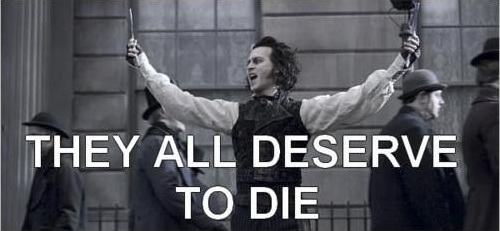
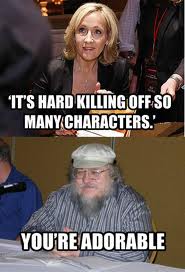
The first example of a story where no one is safe is A Song of Ice and Fire by G.R.R. Martin. One of the catch phrase used in this series of books is actually “Valar Morghulis”, which can be translated as “all men must die”. In the books (as well as in the TV show Game of Thrones that is aired on HBO since 2011), a great number of the major characters die, often brutally and unexpectedly.

The second example I have come across recently is the Starz TV show Spartacus, created by Steven S. DeKnight and Robert Tapert. In this historical drama, the writers’ motto is “Kill Them All”, which translates into the death of almost every single character, save for Spartacus himself.

So I get why killing off characters can be a useful writing device. When the reader has become invested in sympathetic characters, it is always a great emotional shock to see those beloved characters die, especially if those deaths are paired with acts of bravery and/or selflessness. For the writer, the death of a character can also be a great way to move the plot along. For example, at the beginning of the second season of Supernatural (a CW TV show), the death of the heroes’ father was a great way to get the story forward. In the Harry Potter series, the deaths of Sirius Black (in Harry Potter and the Order of the Phoenix) and Albus Dumbledore (in Harry Potter and the Half-Blood Prince) were impressive plot devices that made the young characters grow up and move forward despite their grief.

What I am questioning here, however, is the over-use of the device. In a way, G.R.R. Martin and the writers of Spartacus have painted themselves into a corner, because their readers/viewers now know that they shouldn’t invest too much in characters that are going to die anyway. Also the element of surprise is gone: when you get to Book 5 of A Song of Ice and Fire, you basically expect everyone to die. In this case, the reader/viewer feels cheated because instead of being presented with a great plot and believable tragic events, he is faced with yet another character’s death that doesn’t stir any emotion in him and harms the plot instead of moving it forward.

So what do you think? Do you read or write stories in which everybody dies?

Before wrapping up this post, a few words about my ROW80 goals:

1-      Write everyday: 5/7 days. This week I wrote every day except for Thursday and Friday when my day job took over my life.

2-      Self-edit The Last Queen: not exactly done. I have actually added a few scenes to the novel instead of editing it down. Argh.

3-      Continue writing the first draft of The Cursed King: done, but only a few hundred words.

Here is the Linky for the other ROW80 participants. How have you been doing?

A Round of Words in 80 Days – Round 3 – Check-in #1

Hello gentle reader,

My blog is four months old today! And I am very close to have 100 followers, how exciting is that?! Thanks to everyone who has supported me and this blog in the past few months. You’ve made this blogging endeavour worth it…

So it is now July and I have decided to join the awesome writing challenge that is A Round of Words in 80 Days (aka ROW80) for the second time. Created by Kait Nolan, it is “the writing challenge that knows you have a life”, or “the challenge that champions the marriage of writing and real life.” Unlike NaNoWriMo which runs for only a month, each ROW80 round runs for 80 days and the participating writers have to set themselves writing goals for that time. Each Wednesday and Sunday, we check in and let the others know how we are doing. The idea is to form writing habits that writers will hopefully continue once the challenge is over.

Thus after my JuNoWriMo debacle (during which I have learned that one cannot spend an average of 9.1 hours per day at work AND write a 50.000 words novel), I am back to doing a writing challenge that will actually fit into my crazy daily schedule.

So here are my goals for this round:

1-      Write everyday

2-      Self-edit The Last Queen

This was one of my goals for the last round and I did complete it, however since then I have heard Back from a few beta readers/agents and I have some new editing to do.

3-      Continue writing the first draft of The Cursed King

This is the second book in my DARKLANDS epic fantasy trilogy (more info here) and I really want to finish a first draft during this round.

Round Three starts on Monday, July 2nd and will end on Thursday, September 20th.

If you would like to join in this writing challenge and become a part of the ROW80 community, here are the rules:

  1. Post a goals post in which you lay out your goals for this round.
  2. Post a check-in post every Wednesday and Sunday, in which you share your progress with the other ROW80 participants.
  3. Comment on other participants’ check-in posts.

Here is the Linky for the other participants’ posts. What are your ROW80 goals for this round?