ROW80: Final Check-In

ROW80 Logo

Hello gentle reader,

And we’ve come to the end of this 4th round of A Round Of Words in 80 Days (aka ROW80). My goal for this round was to write or edit every day and I’m pleased to say this has been my most productive round so far (this was my third participation). For at least 6 weeks I had a 100% sucess rate and even in the last few weeks, when work really got crazy and I couldn’t find the time to write every day, I did get a lot done.

So this round, I have:

– edited my WIP The Last Queen (thanks to a few awesome CPs and beta readers) and started querying it.

– added a few chapters to my two other WIPs.

– took part in the launch of a new blog along some writerly friends. The blog is called There And Draft Again and you can check it out here.

Here I’d like to thank Juliana Haygert and Lauren Garafalo for cheering me along during the Twitter sprints. You ladies are awesome!

See you all next round!

In the meantime, keep writing…

ROW80 Check-In 6 & Sunshine Award

Hello gentle reader,

So I had a crazy week, and for the first time since the beginning of this round, I didn’t meet my ROW80 goal, which is to: Write or edit every day. You also won’t find an inspiring story along with this post, simply because I didn’t have the time to find one.

Here is my week in numbers:

Number of hours spent editing/writing this week: 4

Number of hours spent at my day job: 54

Number of work-related dinner parties I attended: 2

Number of pest control interventions because of a wasp invasion in my kitchen: 1

Number of YA authors interviewed on my blog: 1 (you can read the interview here)

Number of writing contests I entered: 1

Number of awards my blog received: 1

Rhiann Wynn-Nolet was kind enough to pass on to me the Sunshine Award. This award is for “bloggers who positively and creatively inspire others in the blogosphere”. Although I am very flattered to receive this award, I am not going to answer the questions that go with it simply because they are all about my favourite food, my favourite colour and my favourite flower, and I don’t see how this can be interesting for you, gentle reader. I am also supposed to nominate 10 bloggers for this award, so I’ll just say: if you’re reading this and you’re doing ROW80, consider yourself (and your blog) nominated.

Hope you all have a great week! Here is the Linky to support each other.

ROW80 Check-In 3: Bree Despain’s Writing Tips


Hello gentle reader,

And it is time for a third ROW80 check-in! My goals for this fourth round are as follows:

Write or edit every day

Editing – Finish my current round of editing for The Last Queen, get my manuscript critiqued and beat-read, then edit some more.

I haven’t done any editing this week since I’m waiting to hear back from my CPs and beta readers.

Writing – Write a short story, and continue writing the first draft of The Cursed King

DONE : I worked on The Cursed King but progress was slow this week, although I did write every day except for Wednesday.

So this was again a good writing week for me and I don’t feel that I need to adjust my goals. This week I also managed to read one book and I kept my blog alive by taking part in The Next Big Thing blog hop: feel free to have a look if you want to know more about my WIP.

Now, on to an inspiring story to keep us going this coming week. Today I’m quoting bestselling YA author Bree Despain. I found the following on her website. Bree is an American author who has a degree in creative writing. She started writing full-time after being involved in a car accident and she has written three novels in her DARK DIVINE series.

Writing Tips

  1. Be a sponge. The more knowledge you can soak up, the better your writing will become. Take writing classes, attend writing conferences, and read as much as you can. There are plenty of online resources for writing classes, but if you can, take an in-person class at a local university or writing conference. There is something very energizing about sitting in a room with a bunch of other writers. And you will probably learn more from in-class debates, and critiquing other writer’s stuff, than you will from reading a computer screen filled with writing tips . . . hey, wait a second . . .hehe. Keep reading anyway 😀
  2. Don’t forget to write. Okay, that sounds silly . . . but really, it happens. Sometimes we get so absorbed in the task of learning about our craft, that we don’t actually ever sit down and do the writing. Or sometimes, we experience “information overload” and we get so overwhelmed we just need to unplug from the world in order to start writing. Remember—no amount of reading, class taking, networking, or schmoozing, etc. is going to get you anywhere if you don’t actually write. Write every day if you can. Carry a notebook to capture ideas when they strike you. I actually wrote the prologue for The Dark Divine on the back of a program during church.
  3. Join a critique group. Like I said, there is something magical about being in a room with other writers. And a critique group is a fun, inexpensive way to get feedback, advice, and brainstorming help. Plus, some of my favorite people in the world are my writing chicas.
  4. Let your writing sit for a bit. Like a good piece of cheese, let your writing “age” for a while before you send it out. Stick your manuscript in a drawer for a couple of weeks and then come back to it with fresh eyes. Let your critique group read it over and offer feedback. Sometimes, you may even need to put something away for a long time before you can really see the kinks that need to be worked out. After sending out the original version of The Dark Divine (unsuccessfully) to a few agents back in 2006, I realized that the manuscript needed a major overhaul—but I didn’t know how to do it. I ended up putting that book in a drawer (figuratively speaking) for over a year. I moved on to other projects, and then one day, the answers to my problems with The Dark Divine just started to work themselves out in my mind. I pulled the manuscript out again and spent the next year overhauling it, let it sit for a month, and then sent it out to agents again . . . and a few weeks later I landed the fabulous Agent Ted!
  5. Don’t be unwilling to revise. I’ve said it before and I’ll say it again: GREAT BOOKS AREN’T WRITTEN—THEY’RE REVISED! Revising is just part of writing, and a major part at that. Hardly anything you write will be golden the first time you put it down on paper. You will tweak and revise on your own, with your critique group, in writing classes, at writing conferences, then take your stuff home and revise, revise, and revise it again. And then you’ll send it out to agents, and more likely than not, you’ll end up tweaking and revising your book even more based on the rejections you get. Then you’ll send it out again, and when you land an agent—guess what? He/she’s going to make you revise it some more before it goes out on submissions. And then when you sell your novel . . . well, that’s when the REAL revising starts. And then when you think you can’t possibly revise that darn freaking manuscript one more time . . . they’ll send it to copy editing where you’ll find out that apparently the language you’ve been speaking all your life isn’t actually English . . .Okay, okay, you get my point? Sorry to say it, but you won’t make it anywhere in the publishing biz if you aren’t willing to revise your writing.
  6. Don’t do all of the revisions people suggest to you. I know, I know, I’m such a hypocrite. I just went on telling you that you MUST revise your book, and now I’m saying not to? Okay, before you kick me in the pants, let me explain. You will get a lot of advice on your book, and a lot of critique suggestions—a lot of them will be good suggestions, some . . . well . . . not so much. Or some suggestions might work well for someone else’s story, but don’t jive with your vision for your book. You will even run into a few people who will pretty much want to write your book for you. But remember, you are the author. This is your baby. Take every revision suggestion with a grain of salt. At first, some revision suggestions seem impossible, or highly improbable, or just plain not right for your story. I always sit on revision notes for a few days (sometimes a few weeks) before I implement them. With a little time and perspective, you will be able to sift out the good suggestions from the bad. And sometimes, an impossible suggestion will suddenly click in your head and it will make a huge difference in the quality of your book. But, if after a little time, a revision suggestion still seems off to you—well then, it probably is. Go with your gut, and do what’s right for your story. But always consider WHY a certain suggestion was made. Did a critiquer want you to change Z into X, but that doesn’t sit well with you? Well, then maybe the reason for Z happening is just not clear enough to your reader. Or perhaps after evaluating the suggestion you will realize that Z actually needs to be changed into Y rather than X. I often find that many revisions are a matter of making things clearer. Does that make any sense?
  7. Accept the fact that becoming an author takes time—and a lot of it. Yes, there are those fluke cases where someone writes a book and then has a multi-million-dollar debut book deal six months later. But for the other 99.9% of us, it takes several years to become an author. Ask just about any published author (including Sara Zarr and Laurie Halse Anderson) and they’ll tell you that it takes about 10 years to make a name for yourself in this biz. And most of us are better off because of the time it took to strengthen our writing. I thank my lucky stars that my first novel never sold. I’m extremely grateful that the original version of The Dark Divine was rejected by every agent I sent it to. Your writing may not be ready for publication right now, but if you keep working, and learning, and reading, and writing, it WILL get there someday. Good Luck!
  8. Remember that authors are real people too! I loved telling stories and writing when I was kid. But I seriously thought that authors were this special breed of people, and someone ordinary like me could never become one. I wish I would have figured out a long time ago that anyone—with enough drive and hard work—can become an author. Even a mild mannered citizen like myself :D.

How are you other ROWers doing? Here is the Linky to support each other!

ROW80 Check-In 1: Neil Gaiman’s 8 Rules of Writing

Hello gentle reader,

It is time for my first ROW80 check-in! My goals for this fourth round are as follows:

Write or edit every day

Editing – Finish my current round of editing for The Last Queen, get my manuscript critiqued and beat-read, then edit some more.

Writing – Write a short story, and continue writing the first draft of The Cursed King

I’m happy to report that I’ve had a great writing week, since I did manage to write or edit every day! Some days (Tuesday and Friday) were tough because I got home from work very late, but I still stuck to the routine. I also managed to read two books for my upcoming Halloween post and I kept my blog alive with an interview with YA author Meagan Spooner. Check it out if you want to know how she got published.

If you’re new to this blog, know that I always add an inspiring story to my ROW80 check-ins. This week, I’m sharing Neil Gaiman’s 8 Rules of Writing that I found on the Guardian website. Neil Gaiman is one of my favourite authors and his writing advice is worth a read.

Image by Kimberly Butler

  1. Write
  2. Put one word after another. Find the right word, put it down.
  3. Finish what you’re writing. Whatever you have to do to finish it, finish it.
  4. Put it aside. Read it pretending you’ve never read it before. Show it to friends whose opinion you respect and who like the kind of thing that this is.
  5. Remember: when people tell you something’s wrong or doesn’t work for them, they are almost always right. When they tell you exactly what they think is wrong and how to fix it, they are almost always wrong.
  6. Fix it. Remember that, sooner or later, before it ever reaches perfection, you will have to let it go and move on and start to write the next thing. Perfection is like chasing the horizon. Keep moving.
  7. Laugh at your own jokes.
  8. The main rule of writing is that if you do it with enough assurance and confidence, you’re allowed to do whatever you like. (That may be a rule for life as well as for writing. But it’s definitely true for writing.) So write your story as it needs to be written. Write it ­honestly, and tell it as best you can. I’m not sure that there are any other rules. Not ones that matter.

How are you other ROWers doing? Here is the Linky to support each other!

ROW80 Round 4 – Goals!

October 1st, 2012 (that’s tomorrow!) is the official start date for Round 4 of A Round of Words in 80 Days (aka ROW80). I have decided to join this writing challenge for the third time. Created by Kait Nolan, ROW80 is “the writing challenge that knows you have a life”, or “the challenge that champions the marriage of writing and real life.” Unlike NaNoWriMo which runs for only a month, each ROW80 round runs for 80 days and the participating writers have to set themselves writing goals for that time. Each Wednesday and Sunday, we check in and let the others know how we are doing. The idea is to form writing habits that writers will hopefully continue once the challenge is over.

As you may know if you follow this blog, my daily life is pretty crazy. I have a day job that keeps me extremely busy, I travel a lot and I read tons of books. Fitting some writing time in my schedule is a challenge, but I’m still very intent on getting published one day.

So here are my goals for this round (and yes, I know they haven’t changed much since the last round, but if at first you don’t succeed…):

Write or edit every day

Editing – Finish my current round of editing for The Last Queen, get my manuscript critiqued and beat-read, then edit some more.

Writing – Write a short story, and continue writing the first draft of The Cursed King

Round Four starts on Monday, October 1st and will end on Thursday, December 20th.

If you would like to join in this writing challenge and become a part of the ROW80 community, here are the rules:

  1. Post a goals post in which you lay out your goals for this round.
  2. Post a check-in post every Wednesday and Sunday, in which you share your progress with the other ROW80 participants.
  3. Comment on other participants’ check-in posts.

Here is the Linky for the other participants’ posts. What are your ROW80 goals for this round?

Valar Morghulis : On killing your characters

Hello gentle reader,

for this second ROW80 check-in, I thought I would tackle the issue of killing characters in novels. Let’s say you’ve created a number of interesting and believable characters in your WIP. Is killing off one or all of them going to help or harm your novel?

Over the past few months I have had to consider this question for two reasons:

–          one of the main characters in my epic fantasy novel The Last Queen dies at the end of the book and some of my beta readers have protested against such a death.

–          I have come across several serial stories where killing off characters was an over-used writing device and it made me wonder when killing your characters actually damages your story rather than makes it go forward.

I am not talking here about the horror genre, where killing off all the characters one by one is an expected writing device. I am talking about the other genres, especially Fantasy and Historical Fiction.
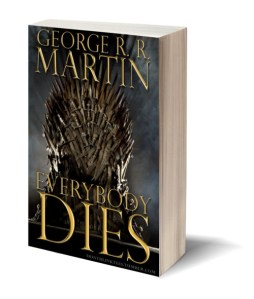
The first example of a story where no one is safe is A Song of Ice and Fire by G.R.R. Martin. One of the catch phrase used in this series of books is actually “Valar Morghulis”, which can be translated as “all men must die”. In the books (as well as in the TV show Game of Thrones that is aired on HBO since 2011), a great number of the major characters die, often brutally and unexpectedly.

The second example I have come across recently is the Starz TV show Spartacus, created by Steven S. DeKnight and Robert Tapert. In this historical drama, the writers’ motto is “Kill Them All”, which translates into the death of almost every single character, save for Spartacus himself.

So I get why killing off characters can be a useful writing device. When the reader has become invested in sympathetic characters, it is always a great emotional shock to see those beloved characters die, especially if those deaths are paired with acts of bravery and/or selflessness. For the writer, the death of a character can also be a great way to move the plot along. For example, at the beginning of the second season of Supernatural (a CW TV show), the death of the heroes’ father was a great way to get the story forward. In the Harry Potter series, the deaths of Sirius Black (in Harry Potter and the Order of the Phoenix) and Albus Dumbledore (in Harry Potter and the Half-Blood Prince) were impressive plot devices that made the young characters grow up and move forward despite their grief.

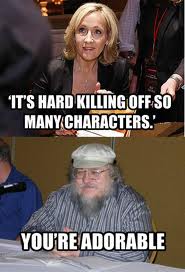
What I am questioning here, however, is the over-use of the device. In a way, G.R.R. Martin and the writers of Spartacus have painted themselves into a corner, because their readers/viewers now know that they shouldn’t invest too much in characters that are going to die anyway. Also the element of surprise is gone: when you get to Book 5 of A Song of Ice and Fire, you basically expect everyone to die. In this case, the reader/viewer feels cheated because instead of being presented with a great plot and believable tragic events, he is faced with yet another character’s death that doesn’t stir any emotion in him and harms the plot instead of moving it forward.

So what do you think? Do you read or write stories in which everybody dies?

Before wrapping up this post, a few words about my ROW80 goals:

1-      Write everyday: 5/7 days. This week I wrote every day except for Thursday and Friday when my day job took over my life.

2-      Self-edit The Last Queen: not exactly done. I have actually added a few scenes to the novel instead of editing it down. Argh.

3-      Continue writing the first draft of The Cursed King: done, but only a few hundred words.

Here is the Linky for the other ROW80 participants. How have you been doing?

A Round of Words in 80 Days – Round 3 – Check-in #1

Hello gentle reader,

My blog is four months old today! And I am very close to have 100 followers, how exciting is that?! Thanks to everyone who has supported me and this blog in the past few months. You’ve made this blogging endeavour worth it…

So it is now July and I have decided to join the awesome writing challenge that is A Round of Words in 80 Days (aka ROW80) for the second time. Created by Kait Nolan, it is “the writing challenge that knows you have a life”, or “the challenge that champions the marriage of writing and real life.” Unlike NaNoWriMo which runs for only a month, each ROW80 round runs for 80 days and the participating writers have to set themselves writing goals for that time. Each Wednesday and Sunday, we check in and let the others know how we are doing. The idea is to form writing habits that writers will hopefully continue once the challenge is over.

Thus after my JuNoWriMo debacle (during which I have learned that one cannot spend an average of 9.1 hours per day at work AND write a 50.000 words novel), I am back to doing a writing challenge that will actually fit into my crazy daily schedule.

So here are my goals for this round:

1-      Write everyday

2-      Self-edit The Last Queen

This was one of my goals for the last round and I did complete it, however since then I have heard Back from a few beta readers/agents and I have some new editing to do.

3-      Continue writing the first draft of The Cursed King

This is the second book in my DARKLANDS epic fantasy trilogy (more info here) and I really want to finish a first draft during this round.

Round Three starts on Monday, July 2nd and will end on Thursday, September 20th.

If you would like to join in this writing challenge and become a part of the ROW80 community, here are the rules:

  1. Post a goals post in which you lay out your goals for this round.
  2. Post a check-in post every Wednesday and Sunday, in which you share your progress with the other ROW80 participants.
  3. Comment on other participants’ check-in posts.

Here is the Linky for the other participants’ posts. What are your ROW80 goals for this round?

ROW80 Check-In #9 and JuNoWriMo update: On Procrastination

Hello gentle reader,

For the past two weeks I have been neglecting my fellow ROWers and instead focusing on the JuNoWriMo writing challenge. For those who don’t know what JuNoWriMo is, check out this post. Oh, and if you’re reading this because you’re looking for my awesome “Clear Your Shelf” Giveaway, you’ll need to look a little bit further: here.

 With JuNoWriMo, my goal is to write every day, even if I don’t make the 50,000-word goal. I hesitated a while before deciding to join in, for two reasons. First, I spend an average of 62 hours a week at work, which means that I only write between 30 minutes and an hour a day. Second, I am a slow writer: I cannot spill 1000 words onto a page in half an hour. So the prospect of having to write an average of 1667 words a day was quite frightening. But I still decided to do the challenge, as it is a great way to keep motivated and to interact with fellow writers.

So how have I been doing, you ask? I have been writing every single day, which I am very happy about. My word count, however, has been lower than the required average of 1667 words a day. As of today my average is 1160 words a day. But I am interacting with fellow writers and keeping motivated (sprints on Twitter are especially good for me!).

What JuNoWriMo has helped me do so far is fighting procrastination. You see, gentle reader, I am terrible when it comes to putting things off. At the beginning of the challenge, I was like this:

Then I set this image as my wall paper on my laptop:

And things got better.

So now, I just…

And it’s been working well so far.

How have you been doing with your writing challenges? Do you have to fight procrastination? How do you do it?

Here is theLinky for the other ROW80 participants…

Have a great week and happy writing!

ROW80 Check-In #8

Hello gentle reader,

I’m late for this check-in, as I have just returned from London (for those of you who don’t live in the UK, we enjoy a four-day weekend here for the Queen’s Diamond Jubilee). Also this is my last ROW80 check-in for this round, as I’m now done with my one and only goal:

self-edit my YA Fantasy novel The Last Queen.

I’m so happy I am done with this I could sing.

And now that The Last Queen is off living its own destiny, I’m now focusing on the JuNoWriMo challenge: my goal is to write every day, even if I don’t make the 50,000-word goal.

So thank you, fellow ROW80ers, this has been very formative for me.

And let’s not forget the Linky

Have a great week and happy writing!

Preparing for JuNoWriMo

Hello gentle reader,

this week I have been getting ready for JuNoWriMo and it is all very exciting…

What is JuNoWriMo?

JuNoWriMo means “June Novel Writing Month”. It was started by Becca J. Campbell and Anna Howard and inspired by NaNoWriMo. The idea is to write the first draft of a 50,000 word book in 30 days. That’s an average of 1667 words per day.  The nice part of the challenge is that you also get to support and interact with other writers.

Getting ready…

The first edition of JuNoWriMo will start on Friday, June 1st and in the meantime, author  Aaron Pogue has been giving his advice on the JuNoWriMo blog to prepare the challenge: in a great series of posts, the idea was to help participants with their synopsis, character description, conflict resolution cycle, and so on… It is worth checking out if you’re interested in prewriting pointers.

Why am I participating?

During the past year, I have written and self-edited the first book in my Epic Fantasy trilogy THE DARKLANDS. I will soon start looking for an agent with it, but in the meantime, I want to take a break from that story. Thus, JuNoWriMo is for me the perfect opportunity to put THE DARKLANDS in a drawer for a month and to work on something else.

This month, I want to write a short YA dystopian novel which has been at the back of my mind for a while. When I say “short”, it is compared to the novel I just finished, which is over 100K… The working title for my JuNoWriMo WIP is BLACK ROSES, but it will most certainly change once I have completed the story. I usually come up with a definite title halfway through the writing process.

What is my JuNoWriMo novel about?

BLACK ROSES is set on the American continent at the end of the 22d Century. A virus has wiped out most of the world population ten years earlier. The only survivors are Humans (who weren’t affected by the virus) and Immortals (who have survived the virus and been turned into supernatural beings). Immortals rule the country and its capital New Wentworth, while Humans live on the margin. However, a third category of people is caught between them: Keepers have survived the virus but haven’t been turned into Immortals. The ruling class needs them in their new society, making them targets for rebel Humans. Seventeen-year-old Nessa is a Keeper. To her, this Friday is just like any other day. She hasn’t planned that Humans would choose it to stage a rebellion, that her life would suddenly be in danger, or that she would fall in love.

Why have I decided to write this specific story for JuNoWriMo?

I have always liked dystopian stories, even when they were just called Science-Fiction. I had the idea for BLACK ROSES years ago: I wrote a synopsis and a few key scenes before filing the thing away. Then the YA dystopian genre took over the world, and I started thinking ‘Maybe I should try and write that story after all.’ I don’t really intend to try and publish it, since the market is now saturated with YA Dystopian stories, but I think I will enjoy writing it in a short amount of time and having my beta readers read it. It will be a good way for me to hone my skills.

Interested in joining the madness?

Sign up for JuNoWriMo here.