ROW80 Check-In 3 On the importance of feedback and beta readers

Welcome gentle reader,

Week 2 of ROW80 (Round 3) has ended and today I wanted to mention the importance of getting feedback on your WIP.

Because writing your novels in a vacuum can only take you so far, there is always a time when you need beta readers in order to make some progress.

“What are beta readers?” you may ask.

According to Wikipedia, “the author or writer, who can be referred to as the alpha reader, may use several beta readers prior to publication. A beta reader (…) can serve as proof-reader of spelling and grammar errors or (…) work on the “flow” of prose. In fiction, the beta reader might highlight plot holes or problems with continuity, characterisation or believability.”
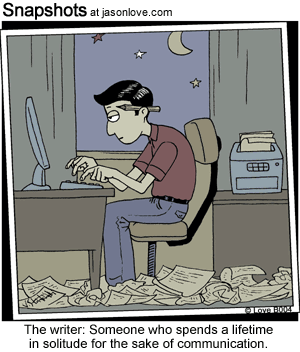
So, I’ll admit it, sending off your Precious Manuscript to beta readers can be scary. No one wants to hear their writing is dreadful and their WIP should be revised from start to finish.

But you need to take that plunge in order to know what your WIP is really worth and to make the appropriate corrections BEFORE you send your Masterpiece to a dozen agents.

Indeed, it is essential to query agents with a manuscript that is in the best possible form in order to maximize your chances of success. If you follow US literary agent Sara Megibow’s #10queriesin10tweets on Twitter, you’ll notice that she receives 200 submissions A DAY. And out of those, she often comments that the writing is “poor” or “weak” or “unclear”. You don’t want to be one of those writers, do you?

So to avoid such rejection, you need to find beta readers who will critique your query/novel/short story. They will find writing issues and they will tell you about it so you can fix them.

Now, how to choose your beta readers?

Even if I’m going against the flow here, I’ll say start with your family and friends. Often, you’re told not to do this because you need critique, not praise, and your relatives tend to just tell you that you are the next big thing. Or they laugh at you. However I have found that getting some of my friends and family members to read my WIP is worth it. Firstly they are all non-writers and they are readers of published YA novels, so it is interesting for me to get their reactions on my own YA novels. One of the earliest comments I got from one of these beta readers was that my WIP was “like a real book.” It was very encouraging for me to hear that my novel could be compared to published YA books. These non-writer beta readers will tell you if your WIP is boring or impossible to understand, if they liked your characters and if they enjoyed reading your story. That’s the first step.

Then you need to find beta readers who are writers themselves. These beta readers are valuable because they will spot writing issues more easily. They will tell you about spelling and grammar errors, about plot issues etc. You can find these beta readers through a writing group, an online community or via your social media platform.

This feedback may or may not be what you want to hear? But if you listen to what your beta readers have to say, you’ll improve your chances of getting published.

Some interesting articles on beta reading:

Susan Dennard http://susandennard.com/2010/05/18/975/

Diary of a Random Fangirl http://therandomfangirl.wordpress.com/2012/04/04/writing-wednesdays-the-importance-of-beta-readers/

Bryan Thomas Schmidt http://bryanthomasschmidt.net/2011/05/21/6-tips-for-being-a-good-beta-reader/

To wrap up this post, my ROW80 progress this week:

1-     Write everyday: 5/7 days. This week I wrote every day except for Tuesday and Saturday. A special thanks to Lauren Garafalo for leading ROW80  sprints on Twitter, they really help!

2-      Self-edit The Last Queen: done. A little bit.

3-      Continue writing the first draft of The Cursed King: not done. Instead I wrote a short story.

Also, this week on my blog, you could:

–       find out how NOT to start your novel or how hook your reader from the first paragraph.

–     read an exclusive interview with YA author Kendare Blake about her writing and how she got her best-selling ghost story Anna Dressed In Blood published.

Here is the Linky for the other check-in posts. How are you other ROW80 writers doing?
A Round of Words in 80 Days – Check-in #4

Let’s review: last week I missed my weekly check-in as I was away from home without an Internet connection. This week I’m back but I’ve had to change my goals, as what I had decided on four weeks ago is no longer attainable, given my personal circumstances (day job and other non-writing obligations).

So let’s have a look at my goals:

1-        Write the first draft of my new dystopian novel with at least 750 words per day: not anymore. I just don’t have the time. So I will probably write this first draft from time to time, but I cannot pretend I can write it every day, with a set number of words.

2-        Self-edit/revise The Last Queen so that I finally have a final draft for it: this is what I have to focus on. I need to be done with that by the end of June and so far this final draft is not ready yet. So it’s Revision, Revision, Revision for me. My manuscript needs to be 20K shorter, so I have to start making serious cuts in it. Samurai like.

That’s it for me. How are you other ROW80 writers doing?

Here is the Linky for the other check-in posts.

This week on my blog you can find:

an interview with YA writer Rebecca Maizel on writing, reading and her books.

a post on YA best-selling author Lauren DeStefano with her advice on writing a book and getting it published.

inspiring pictures!

Happy writing!


A guide to attending international book fairs for would-be-published writers – The London Book Fair 2012

Next Monday I am going to attend the London Book Fair 2012. It will be held at Earls Court, London from the 16th – 18th April. I went there last year during two days and I had a great time, which is why I’m going again this year.

According to its own website, the London Book Fair has been “the global market place and leading business-2-business exhibition for rights negotiation and the sales and distribution of content across print, audio, TV, film and digital channels for 41 years. With over 400 seminars and events, 1,500 international exhibiting companies and 24,500 publishing professionals, The London Book Fair encompasses the broad spectrum of the publishing industry.”

So the question is: is it at all worth it, for a would-be-published writer, to attend such a fair? My answer is yes, IF you are realistic about your expectations.

What won’t happen at the London Book Fair

If you are, like me, a would-be-published author, you shouldn’t go to a book fair (whether in London, New York City or Frankfurt) hoping to get noticed by an agent or a publisher. To me, this is not the place to get your foot in the door by walking up to agents or publishers and dumping your awesome manuscript in their lap.

Agents and publishers who attend those book fairs do so to meet business partners that they already have, not to meet new ones. Unless you were actually given a meeting time by an agent or a publisher at the fair, don’t expect to be able to sit down with them and to pitch them your best-seller in the making. They don’t have time for newcomers who haven’t previously been introduced to them. Even if you “only” want to talk with a specific agent, chances are he is fully booked with meetings with different publishers and book buyers anyway.

If you want to talk to agents and editors, my advice is to attend writers’ conventions/conferences. The agents and editors who attend those are actually expecting to talk to authors.

So should you just give up and not go to the London Book Fair? No. Because here is what will happen there

If you are a would-be-published writer, going to the London Book Fair is still worth the trip for three reasons.

1-      You can attend seminars and workshops and learn A LOT about how the publishing business works. Last year I attended a How To Get Published Masterclass, numerous seminars on the state of the publishing industry and its (digital) future, as well as a few authors/publishers panels. And it was enlightening on many levels. Among others, I got to listen to words of advice from Philip Pullman (best-selling author of children’s fantasy novels, His Dark Material) and Sarah Odedina, the former Bloomsbury Group editor-in-chief who has published all of J.K. Rowling’s Harry Potter books. Talking about people who know their stuff.

2-      You get to have an insight into future publishing trends. It can be a good way to find out whether this great book you’ve been working on is in sync with what those decision-making people actually want to buy/publish.

3-      You meet other would-be-published writers. To paraphrase Kristen Lamb, you are not alone. Other unpublished authors go to those fairs and unlike agents and publishers, they are interested in talking with you. And it’s great to meet and exchange with other writers who are on the exact same “I want to be a writer!” roller-coaster ride you’re currently on. The book fair is the time to connect and make friends.

So what do you think? Are you going to attend the London Book Fair?

To wrap this up (yeah if you’ve read the whole thing!), a few noteworthy websites:

The London Book Fair http://www.londonbookfair.co.uk/

Book Expo America http://www.bookexpoamerica.com/

The Frankfurt Book Fair http://www.buchmesse.de/en/fbf/

Absolute Write Forum (on going to the London Book fair) http://absolutewrite.com/forums/archive/index.php/t-94444.html

Kristen Lamb’s hilarious account of her personal first book fair disaster http://warriorwriters.wordpress.com/?s=book+fair

A writer in the spotlight: Rachel Caine

Today I’m starting a new blog topic: writers’ interviews. I figured published (and bestselling) authors were the best source of advice for us, would-be-published writers. And the wonderful Rachel Caine has agreed to be the first author to be interviewed!

Author : Rachel Caine
Genre : Urban fantasy, paranormal, young adult literature, short fiction
Location:  Texas, USA
Website : www.rachelcaine.com

Books :
The Weather Warden series (9 books, 2003-2010)
The Red Letter Days series (2 books, 2005-2006)
The Morganville Vampires series (15 books, 2006-2013)
The Athena Force series (1 book, 2007)
The Outcast Season series (4 books, 2009-2012)
The Revivalist series (1 book, 2011)

Bio:

Rachel Caine is a New York Times, USA Today and internationally bestselling author of more than 30 novels. She had received numerous literary awards and attended over a hundred conventions and conferences in the past twenty years. She has a bachelor’s degree in business administration from Texas Tech University and she has worked in many jobs, before becoming a full time writer in 2010.

My interview with Rachel (24/03/2012)

On writing:
1.    Did you always know you wanted to be a writer?
Oh NO! I was going to be (in order) an astrobiologist (age 9), a detective (age 12), and a professional musician (ages 14-30). I was a *hobby* writer. But I wrote consistently from age 14 onward.
2.    When and where do you write?
I do my best work in the mornings, the earlier the better, so I try hard to get up at 5 am or so, and work about 8 hours, then knock off for lunch. I usually run errands in the afternoons and work on business items at night.
3.    Do you ever experience writer’s block?
Sure, I think everyone does — but it’s really more of a “day off.” It’s easy to let that day off turn into two, then a week, then a month, and that’s when you’re in trouble. So I never let myself take more than one day off, unless I’m sick. If I get stuck on a story, I try reading it from the beginning, which often does the trick, or if it doesn’t, I jump forward to the next thing I want to write in the timeline.
4.    What do you say to people who want to be writers? How difficult is it to get published?
That’s a complicated question now — much more so than when I started. The easy answer is “not difficult at all” because things like Kindle Direct make it possible to write something and put it out for sale digitally immediately. The HARD part of that is that when you do that, you’re likely doing it way too soon. Becoming a writer is a craft and a skill … something you acquire slowly over time, usually. Your first efforts probably won’t be that great (mine certainly weren’t). In fact, your 10th effort may not be great, either. People grow at different rates in their craft — and the way you find out you’re not ready, in traditional publishing, is that you compete with others for the limited opportunities available. The better you get, the more chance you have to grab that chance. It’s a process that creates not *more* writers, but *better* writers, which is why I still like it.
But more than likely, things will change even more over the next few years … so the answer is: yes, it’s probably pretty easy now. But easy isn’t always a good thing. And it’s still hard to get in with the big professional publishers, and always will be.
5.    Is it better to outline and plot your novel or “go with the flow”?
That depends. Some people work better to go “seat of the pants” … and some won’t start a road trip without a map. I’m a bit of both … I like a road map, but I’m not averse to taking interesting side roads too. I usually have a loose outline.
6.    Do you set goals for yourself as you write?
The deadlines really set them for me — I have a book due every three months, at 100,000 words, so that means I have to write a thousand words a day. The more days off I take, the higher that number gets!

On “The Morganville Vampires” series:
7.    To write this specific series, where did you get your inspiration from?
In the beginning, it was the idea of the town itself … all the layers of secrets (Vampires! Sick vampires! Sick vampires who are the last of their kind! With a secret enemy! … and on and on.) That really excited me.
8.    How did you come up with those characters? Are they based on real people?
I don’t base my characters on real people as a rule, but some of the vampires are historical people. I started with Claire and figured out what she was like, and then filled in characters around her. (And continue to do that!)
9.    What type of music do you listen to when you write this series?
I listen to many different kinds of music, and I find I need NEW music every book … so the first thing I do when I start is pick a few songs to start out with, and look for more music as I go. I tend to like alternative music, with a good sprinkling of pop, rock, some classics, even soundtrack music.
10. What are you working on now? Is it a Morganville Vampires book?
It is! I’m working on Book 13, BITTER BLOOD. And it’s due next week!

Reading advice:
11. Which authors inspire you now?
Every author I read inspires me in some way. We’ve all got strengths and weaknesses as writers … I look for what the other writer does especially well, because it’s usually something I *don’t* do as well. Most of the writers I’ve met are inspiring people as well … beautiful and gracious people!

Oh, okay, if you want me to be *specific,* … Charlaine Harris. Richelle Mead. Melissa Marr. Kelley Armstrong. Jim Butcher. George R.R. Martin.

12. Which YA books would recommend?
There are SO many good ones! I will always recommend Jackie Kessler’s Four Horsemen series … it’s brilliant. Tough and uncompromising, but brilliant. Heather Brewer’s books. Suzanne Collins. Beth Revis. The fabulous Cassandra Claire. Ann Aguirre. And ALWAYS Holly Black. But that only scratches the surface … there are so many amazing writers in YA, and more coming daily — just dig in! It’s a literary feast!

Rachel Caine will be in England from May 4th to May 24th 2012. Check her website for more details.