On Querying , Subjectivity and Getting Contradictory Feedback from Agents

Hello gentle reader,

I’ve blogged before about the Querying Process and the 4 Stages of Rejections. In my previous post, I explained Stage 4 as the moment when you’re getting requests left and right, which all turn into “I like it but I’ll pass” rejections.

Today I’d like to expand a little bit on this type of rejection.

If you’re in the querying trenches and getting a lot of form rejections, you might think that receiving personalized feedback from agents is great: at last, agents take time out of their busy schedule to let you know WHY they’re rejecting your manuscript and what you can do about it! When I was querying for the first time, I thought so too.

Except that sometimes, the agent’s feedback isn’t as helpful as we hope.

When I queried the manuscript that led me to signing with my agent, I had 19 requests. I received personalized feedback from 16 agents (which, incidentally, means that two agents form-rejected my full manuscript – that can happen too).

Now, if half these agents had given me the same reason for rejecting my work, I would have gone back to the drawing board and revised. But it’s not what happened.

Instead, I received a lot of “I’m not the right agent for this” replies. Fair enough. I understand an agent has to believe in a project with a fiery passion to sell it to editors.

But then I also received the oh-so-confusing Contradictory Feedback (NB: my main character is named Lily):

Agent 1: “I had some trouble with Lily’s voice.”

Agent 2: “I just didn’t find myself to be as hooked by Lily and her narrative voice as I had hoped to be.”

Agent 3: “I thought the voice was great.”

Agent 4: “I’m afraid I wasn’t able to connect to Lily’s voice.”

Agent 5: “I just LOVE Lily’s voice.”

These quotes are not made up. They are straight from my inbox.

Are you seeing a pattern here? Yes. It’s the Pattern of The Contradictory Feedback From Agents.

Now, what does this tell us? It tells us that when you reach Stage 4 of the Querying Process, it’s likely your manuscript is polished and good enough to find representation. And when agents reject it, it reminds us that the publishing business is subjective.

And it’s an important lesson, because the rest of our publishing journey will also be affected by subjectivity. From editors to readers, we’ll have people who won’t like out story, hopefully not because it’s bad, but because it just isn’t their cup of tea. And it shouldn’t get us down: we can’t please everyone. We just have to be grateful for the people who do enjoy our stories.

And don’t forget…

What about you? Have you been confronted with subjectivity in your publishing journey? How do you deal with contradictory feedback? Make sure to leave me a comment below!

The Agent Announcement

Hello gentle reader,

Remember how short my Year In Retrospect post was a couple of weeks ago? That’s because things were happening and I couldn’t talk about it yet. Now you get the full story of My Year 2013 aka The Year I Got An Agent.

The short version

I’m thrilled to announce that I’ve signed with Erin Niumata of Folio Literary Management. The manuscript which helped me find an agent is entitled LILY IN THE SHADOWS and you can find out more about it here.

The stats

I know querying writers like statistics, so here goes…

Queries sent: 33

Requests: 19 (including 13 full requests)

R&Rs: 4

Offers: 2

Time between first full request and offer of rep: 6 months

Here I’d like to point out that even if you’re querying successfully (i.e. you’re getting requests, positive feedback and R&Rs), the querying process can take a long time. I’ve read MANY posts by writers who signed with their agents only a couple of months after sending out their first query. It’s not necessarily the norm.  Out of the 13 agents who read my full manuscript, the quickest one took 1 week and the slowest one 4 months. Their average reading time was 10 weeks.

The long version

Before 2013

1998-2009 I write stories

2010 I write a sci-fi novel and ask my former English teachers to read it. Incredibly, they don’t think my idea of getting it published is crazy.

2011 I start 4 novels, and can’t finish any of them. I start reading about this whole publishing business. I read Claire Legrand’s blog and daydream that one day, I’ll have an agent too.

2012 I start a blog. I write a YA Epic Fantasy. I query it, get a couple of requests, and lots of rejections. I find a Critique Partner. I read Susan Dennard’s blog and decide to follow her amazing advice. I open a Twitter account. I join the ROW80 fun. I shelve my YA Epic Fantasy.

2013

January

I have a notebook. On the first page, I’ve written “Flower girl in Victorian London”. After watching Les Miserables at the cinema, one evening at the castle, I decide it’s time to write epic stories again. I sit down and open a Word document, with the title “Lily In The Shadows”.

February

Thanks to the ROW80 sprints (every day at 2pm EST), I write 20k words. I research Victorian London. I outline. Every time an agent mentions somewhere online she is looking for Historical/Victorian/Gaslamp Fantasy, I add her to my “Agents to query” list. I’m determined to do this right, gentle reader.

March

I go to the SCBWI Conference in Paris with my first 10 pages, and a synopsis. I have a One-on-One Critique Session with an Agent, who requests to read my full manuscript.

April – May – June

I finish writing Lily In The Shadows. I revise it based on my CPs/beta readers’ feedback. I enter giveaways and win query critiques, first pages critiques and even a full MS critique. You’d be surprised at how few people enter this kind of giveaways. Yet I cannot stress enough how much it helped me write a stellar submission package – and for free!

July

I send my manuscript to the agent who requested it in Paris. I enter two contests: Christmas In July (organized by the fabulous Michelle Krys and Ruth Lauren Steven) and Like A Virgin (organized by the wonderful Kristina Perez and Rhiann Wynn-Nolet) and to my astonishment, Lily In The Shadows is a finalist in both contests. That same month, I take part in the PitchMas Twitter Pitch Party and I get 3 requests, including one from Erin.

August

Given what happened in July, I decide to throw caution to the wind and to query the 22 agents on my To-Query list all at the same time. I know people say to send only a few queries at a time, and to wait for feedback before sending more, but with the contests’ results I hoped that my query/first pages were good enough. I was READY, lovely reader.


September

I get requests. I get rejections. I get R&Rs. I tweet my pitch again during PitMad and get 5 more requests. I have excited DM conversations with my writerly friends on Twitter. I have depressed DM conversations with my writerly friends on Twitter. I believe in myself. I doubt myself. I’m not sure I’m very productive at work.

October – November

Based on the 4 (!) R&Rs I’ve received, I completely rewrite my manuscript. Then it’s off to CPs and beta readers again, before I send it to agents in…

December

Things get crazy. I have agents asking me for additional material (aka my other WIPs). I have agents asking me how many agents are currently reading my MS. I have an agent who refers me to another agent. Then on 16th December, Erin emails to ask if I have time to talk.

2014

The Call happens on Thursday 2d January. Yes, that’s 2 weeks after Erin’s email. I told you things don’t always happen overnight. At that time, 4 agents are still reading my full manuscript, and 2 have a partial. Some nudging later, I have 1 additional full request, 1 more offer of representation and 4 passes. I wait the required week (and give the agent who belatedly requested my full enough time to read it) before saying yes to Erin on 10th January. Erin tweets this on the same day:
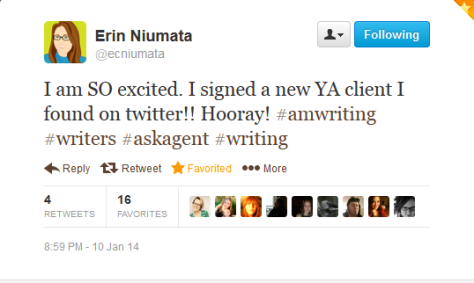
Tweet Erin

Best. Subtweet. Ever.

I sign the contract on 13th January.

 Thank you

To my amazing CPs: Jessy Rubinkowski and Allie Schellong

To my Beta Readers: Jani Grey, Bridget Shepherd, Serena Lawless, Kate Michael, Cassandra Marshall, Jenny Perinovic and Marieke Nijkamp.

To my cheerleaders: Lauren Garafalo, Rachel O’Laughlin and Aimee L. Salter.

To the people who helped with my query/synopsis/first page: Veronica Park, The Writer Diaries, Stephanie Diaz and Stacey Lee.

Now that I’m done with the querying process, I’ll be able to blog about topics I avoided before, such as How to deal with a request for exclusivity or with a referral, or What happens during The Call (and what doesn’t), etc.

But in the meantime, feel free to ask me your questions below!

Writers and Publishing Trends

Hello gentle reader,

On 27th September 2013, Publishers Weekly published an article about new trends in YA. Such articles appear every so often, informing us of what’s “in” and what’s “out” and attempting to predict YA readers’ future tastes.

Right now, Paranormal, Dystopian, Greek mythology, Sci-Fi, mermaids, vampires, werewolves and trilogies are not what editors are looking for. They are more interested in realistic contemporary fiction, thrillers, fantasy, mysteries and stand-alones.

As for what will be popular in a year, no one has a clue.

So what are we, writers, to do with such information?

Should we care about trends?

Writers wishing to get traditionally published should be aware of trends. Querying a paranormal manuscript with vampires and Greek gods in 2013 will only bring on rejections and disappointment. This is why writers are encouraged to read widely in their genre, and to stay informed of what’s happening in the publishing world (book fairs and specialised websites are a great way to find such information).

Should trends affect our writing?

Let’s be clear. I strongly believe you should write whatever you want, regardless of trends. Write that vampire book if it makes you happy: you will be honing your writing skills if anything else. Trends only come into play when you want to publish said book.

On the other hand, don’t try to write according to trends: your book will be out in 18 months at the earliest. By that time trends will have changed 3 times.

So what are we to do?

Write a book as original as possible within its genre, with an interesting plot, a great voice, unique characters and beautiful writing. Think about what makes it stand out from other books on the market.

This is what agents and publishers are looking for. This is the next trend.

Querying, dream agents and the right agent for you

Hello gentle reader,

This post was inspired by some FizzyWisdom I read yesterday, aka a blog post by the amazing Summer Heacock about what you should and shouldn’t share on social media while you’re querying your manuscript. In her post, Summer explains how oversharing online can hinder your chances of finding an agent. She also mentions the term “Dream Agent”, which is the topic I want to discuss today.

What is a “Dream Agent”?

If you’re a querying writer, a Dream Agent is the agent you really, really want to sign with. This agent is whoever you think will be the perfect match for you and your writing.

Does everyone have a Dream Agent?

Sometimes, it sounds like everyone is talking about their Dream Agent, or asking who your Dream Agent is. I’m going to be very honest here and say I don’t have a Dream Agent. I have maybe 12 Dream Agents. Why? Because I want to keep my options open. Because a Dream Agent, an agent you *think* will be a perfect match, isn’t necessarily the Right Agent for you, that is, an agent who *will be* your perfect match.

How do I go about finding the Right Agent for me, then?

Do your research and find out:

  • if the agent represents your genre and is in contact with publishers interested in your genre.
  • what’s the agent’s style: editorial or non-editorial? Happy to communicate with you often or preferring to get in touch only when necessary? This info is usually available on the agent’s website or blog.
  • the agent’s sales record (how many books they sold, to whom and when): this info is available on Publishers Marketplace.
  • if the agent is an AAR (Association of Author Representatives) member. Sometimes new agents aren’t AAR members but they should work for an agency with AAR members (aka an established agency with a sales record). You can find this info on Query Tracker.
  • where the agent lives:  with Internet, whether the agent lives in London, New York or Los Angeles shouldn’t be an issue for your book to sell. However do check where the agent lives to consider if her/his location will have an impact on your relationship (time difference anyone?)
  • what’s the agent’s personality: this is where things get a bit subjective, but checking an agent’s online presence can help you determine whether she/he is the right agent for you. Twitter is a good resource for this, or agents’ blogs and Tumblr.

But the final decision about whether an agent is right for you or not will be during The Call: when an agent makes an offer of representation. This is when you will be able to judge if the agent’s vision of your book and your career matches your dream. Then hopefully, you’ll decide this agent is the Right one, aka your Dream Agent.

What about you? Do you have a Dream Agent? How do you go about finding out if an agent is the right one for you? Make sure to leave me your comments and questions below!

Getting published: finding your own path and going at your own pace

Hello gentle reader,

In 2010, I wrote a Sci-Fi novel and I sent it to my former English teacher with a question: “Is this good enough to be published?” Incredibly – given the poor quality of my Masterpiece – she didn’t say “NO WAY”. Instead she told me: “If you work hard and you really want this, I don’t see why not.”

So I embarked on my very own publishing journey, full of hopes and dreams. I chose the traditional route, because it was what felt like the best way for me and my stories. It still feels that way, actually.


Soon enough, I found other writers on the same path: people writing a manuscript, or people with a manuscript looking for an agent. I read their blog, followed them on Twitter, made a lot of writerly friends with whom I could share the aforementioned hopes and dreams.

I wrote another novel (a YA High Fantasy), found beta readers and Critique Partners, and after a year I queried it.

It turned out finding an agent who loved my manuscript was even harder than predicted.

At the end of 2012, I made the decision to shelve my YA High Fantasy and to start working on another story.

I began writing a YA Victorian Fantasy.

In the meantime, I started noticing the writing community around me had changed.

Some simply quit and disappeared, sometimes with one last blog post explaining their decision, sometimes without a whisper.

Some got an agent and later on a publishing deal, leaving the shore of unpublished writers for the land of authors.

Others got a publishing deal with a small press or an independent publisher, and saw their book come out within 9 months or a year.

And a staggering, STAGGERING number decided to self-publish.

Now, I’m not criticising the last two publishing paths in the slightest. I just know one thing: those publishing options aren’t for me. Self-publishing is way more work than I can handle, and dealing with a publisher (whatever its size) means I need an agent to tell me what (not) to do.

Three years on, and I now find myself rather lonely on my publishing road.

Out of all the writers I met online or in person in the past 3 years, many, many of them now have a book out or a soon-to-be-published book.

And I’m still walking on the path, with my manuscript in hand and my hopes and dreams with me, forever convinced I will find the right agent and traditional publisher in the end.

And it struck me the other day that maybe I’m not as alone as I think in this situation.

When you spend a lot of time around the writing community, it sometimes feels like EVERYONE you know now has an agent and/or a book out.

But it’s not true. We just hear more about those who have exciting news than about those who are STILL looking for an agent after three years.

So if you’re one of those lonely writers without news for the world, remember this:

–          Going at your own pace is fine. What matters is getting where you want.

–          Don’t give up on your traditional publishing dream because it’s slow to come true.

–          Don’t give up, period.

–          Write the best book you can, and do your best, always. Someone will notice in the end.

–          Enjoy the journey without worrying about what others accomplish. One day, you will accomplish those things too.

And never stop writing.

Writing Contests Round-Up (Autumn Edition)

Hello gentle reader,

The lovely Natasha M. Heck asked me if I could write a post about writing contests for querying writers. There are many coming up, which I have listed below. Hoping this helps!

NB: The contests I mention here are for unagented writers with a finished/polished manuscript. Their goal is to offer you the chance to get your writing on an agent’s desk.

So without further ado, all your autumn writing contests… in one place!

Contest: Trick or Treat with Agents 2013

Date(s): Submissions on Tuesday 22d October

Organised by: Kimberly P. Chase, Brenda Drake and Dannie Morin

Open to: MG,YA, NA, and Adult. (No Erotica or Memoirs)

How to enter: 3-sentence pitch + first 250 words + answer 2 questions

Cost: Free

More info: http://kimberlypchase.blogspot.co.uk/2013/09/trick-or-treat-with-agents-2013.html

Contest: 2013 Baker’s Dozen

Date(s): 29th to 31st October for Adult submissions, 5th to 7th November for YA and MG fiction

Organised by: Miss Snark’s First Victim (aka Authoress)

Open to: MG and YA (all genres) – Adult (all genres except erotica and erotic romance)

How to enter: a logline (= a 1 to 2-sentence pitch that encapsulates your story & makes us want to read it) + first 250 words

Cost: $10 entry fee

More info: http://misssnarksfirstvictim.blogspot.co.uk/2013/09/the-fourth-annual-bakers-dozen-facts.html

Contest: Mystery Agent

Date(s): 1st of each month

Organised by: Operation Awesome

Open to: Depends on the judging agent

How to enter: one-line pitch or 250 first words

Cost: Free

More info: http://operationawesome6.blogspot.fr/

Contest: Secret Agent contest

Date(s): November (date TBA)

Organised by: Miss Snark’s First Victim (aka Authoress)

Open to: Depends on the judging agent

How to enter: first 250 words

Cost: Free

More info: http://misssnarksfirstvictim.blogspot.co.uk/p/secret-agent.html

Contest: Pitch Wars

Date(s): December (date TBA)

Organised by: Brenda Drake

How to enter: TBA

Cost: TBA

More info: http://brenleedrake.blogspot.co.uk/

So tell me: are you going to enter those contests? Are there any other contests this autumn I haven’t heard about? Feel free to leave me a comment below!

Querying and dealing with an R&R (Revise and Resubmit)

Hello gentle reader,

In previous posts, I have explained how to maximize your chances of success during the querying process, how to make sense of rejections and when to make the decision to shelve your manuscript.

From those posts, you might have assumed there are only two endings to the querying process: rejection (“NO”) or offer of representation (“YES”).  But there is a third option, which I shall address here: the “Revise and Resubmit” option, aka “R&R”, aka “MAYBE-NOT-YET”.

What is an R&R?

It’s a letter (these days, it’s usually an email) from an agent who has read your full manuscript. This agent sees enough potential in your story to write you a letter, but she’s not ready to offer you representation just yet. Instead, she asks you to revise (according to her helpful suggestions) and resubmit your manuscript at a later time.

Is this good news?

It might not look like it at first glance, but it IS great news. Agents are busy people. Yet one of them saw enough potential in your story to write you pages of suggestions to improve it. Not only did this agent read your whole manuscript, but she thought about it during her daily commute and then sat down at her desk to write you a 3-page email.

What do I do now?

It’s entirely up to you. You may decide to go ahead with the revisions or you may decide to ignore them and carry on querying. Here are the questions you can yourself in order to make that decision:

–          Do you agree with the agent’s suggestions?

–          Do you feel capable of doing the required revisions?

If your answer is yes to both questions, then go ahead and revise. If you’re unsure, discuss it with your Critique Partners. Take your time and think about it: you need to be fully committed to these revisions; otherwise you’re just wasting your time.

Is this a test?

In a way, yes, it is.

The agent sees a spark in your manuscript, and she’s testing you in order to see if you are able to revise it according to her comments. You’re a potential client.

And for you, this is the opportunity to find out if you like the agent’s style and editorial approach. For a few months, she’s your potential agent.

How long do I have to complete those revisions?

That’s the tricky part. You’ve got AS LONG AS YOU WANT. An R&R is a great opportunity to show yourself and your story in the best light possible. There’s no need to rush. At the same time, most agents say that taking forever doesn’t send the best message, because they start doubting you can handle revisions in a timely manner. So between 1 month and 6 months is acceptable.

What happens when I resubmit?

Hopefully this time, the agent’s reply will be an offer of representation. BUT IT DOESN’T HAVE TO BE. The agent can ask for another R&R. The agent might send you a rejection after all. But in the meantime, you’ve made your manuscript stronger, and it might just be what will help you find an(other) agent after all.

So tell me: have you had an R&R before? How did you deal with it? Do you have any questions? Feel free to leave me a comment below!

Querying and the decision to shelve your manuscript

Side note: this post is not about my personal situation. It was inspired by conversations I’ve had this week with other writers. I’m not shelving Lily In The Shadows (just yet).

Two weeks ago I wrote a post about querying and rejections. I offered advice on what to do to make it out of the slushpile and get an agent’s attention – and hopefully an offer of representation. Today’s post is about the other side of the coin: what to do when, despite your best efforts, that offer of representation doesn’t come and you’re faced with the decision of shelving your manuscript.

Making the decision your Beloved Manuscript isn’t The One is hard. You’ve put so much effort into it, you love it so much, how do you know it’s time to move on? Here are a few questions to ask yourself before you make your decision:

1- Is your submission the best it can be?

The first question you need to ask yourself is whether you’re getting rejections because of the quality of your submission. If, deep down, you know your query could be better, your first pages could be rewritten and your manuscript could use more polishing, ask yourself if it’s not worth a little extra work. If you think it is, just walk that extra mile and make your submission outstanding.

2- Have you exhausted all your querying opportunities?

The second question you need to address is whether you have queried all the agents interested in your genre/category. If the answer is no, then keep querying. If the answer is yes and you feel you’ve burned all those bridges, it might be time to move on.

3- Is it just down to bad timing?

Maybe there’s nothing wrong with  your query or manuscript. Maybe you’re getting rejections because your timing is unfortunate. Ask yourself if you’re querying a genre that’s over-represented in the slushpile. The NewLeafLiterary Tumblr is a great source of info on that matter. Right now, Dystopian, Greek mythology, Sci-Fi, mermaids, vampires and werewolves are not what editors are looking for. Be aware of these trends when trying to decide whether or not you should give up on querying your story.

4- Am I shelving this manuscript forever?

Parting ways with a manuscript you love is hard. But knowing there’s a chance it might still hit the shelves one day can help you putting it aside for now. Maybe, once you have an agent thanks to another manuscript, you can take your beloved manuscript out of the drawer and send it out on submission.

5- Can I move on from here?

Although it may seem unthinkable at the moment, moving on is possible. Write another story. Focus on another project. It may be the one that will get you an agent. And you won’t regret shelving your Beloved Manuscript then.

Have you ever shelved a manuscript you loved? What brought you to that decision? Do share your experience below or ask questions I haven’t thought of!

Querying, making sense of rejections and finding the right agent

Hello gentle reader,

September is just around the corner, and for some of you it might mean a new step in your writing endeavours: the querying process.

For the purpose of this post, we are going to assume you’ve done your homework, finished and polished your manuscript, written a professional query letter and put together a list of agents to contact, along with their submission guidelines. You’ve read all the success stories about writers who got multiple offers one week after sending out their query and signed with an agent within 3 months. So you send out a batch of queries and you start drafting your “How I got my agent” blog post while refreshing your inbox. You’re ready for the offers of representation to roll in.

Except instead, rejections start piling up.

And you have no idea where things have gone wrong.

So here is a little 4-stage guide to help you make sense of those rejections and hopefully help you on your way to finding your perfect agent match.

Stage 1

The problem: You’re getting form rejections, with one or two random partial requests thrown in to keep you guessing.

The diagnostic: At this stage, it’s likely the issue lies with your query letter. “But,” you’ll say, “my letter follows the guidelines and doesn’t even mention Harry Potter!” Fair enough. But to compete with the hundreds of query letters that land each month in the literary agent’s inbox, your letter has to stand out and be stellar.

The solution: Revise your query letter. Post it on forums like Agent Query Connect, Absolute Write or WriteOnCon. Enter contests and giveaways offering a query letter critique. Revise again. Re-draft until your letter is concise, clear, eye-catching and true to your story. Writing an outstanding query letter might take 20 or 30 drafts, but if it gets your manuscript requested, who’s counting?

Stage 2

The problem: You’re getting partial requests, which turn into rejections with a personal comment from the agent.

The diagnostic: There’s something wrong with your first 50 pages. Whether it’s pace, characterization or plot holes, hopefully you’re getting the same feedback at least a couple times.

The solution: Revise your manuscript. Work with your Critique Partners to fix your manuscript’s issues. Once your revisions are done, send your story to beta readers who haven’t read it before and listen to their feedback. Enter contests and giveaways to win a manuscript critique from an editor, an author or even better, an agent.

Stage 3

The problem: You’re getting full requests, which turn into rejections with detailed feedback or a Revise and Resubmit (R&R) request.

The diagnostic: There’s something wrong with your manuscript, and agents highlight what it is.

The solution: Again, revise, get feedback, revise again, and resend.

Stage 4

The problem: You’re getting requests left and right, which all turn into “I like it but I’ll pass” rejections (aka the “not for me but best of luck with it” rejection, aka the “not the right fit for me at the moment” rejection, aka the “I didn’t fall in love with it” rejection).

The diagnostic: It’s the hardest one, because there’s nothing wrong with your query letter or your manuscript. Nothing the agents are telling you about anyways.

The solution: KEEP QUERYING. You’re so close to your goal, the next agent you’ll contact might be the one falling in love with your story. And this is the one agent you want, the best possible match, the one who will wholly believe in your manuscript’s potential.

So tell me: which stage of the querying process are you at now? Do you have any questions I didn’t answer in this post? Or any advice for other querying writers? Feel free to leave me a comment below!

Querying a book during the summer: a few tips

Hello gentle reader,

Yesterday on Twitter the very talented Heather Marie ‏(@xHeatherxMariex) and DahliaAdler ‏(@MissDahlELama) had a discussion on whether or not it was a good idea to query a book during the summer. You can read it here if you’re interested (and you should also follow these two amazing ladies!).

I’ve often heard it’s better to forget querying from mid-June to mid-August, and this was Heather’s opinion: her point was that when agents and editors are out-of-office for various reasons, writers are less likely to get replies and they should therefore wait until September to contact them.

But what if your manuscript is ready now? Aren’t you wasting precious time if you wait two months to query it? As Heather pointed out at the end of the Twitter conversation: the decision to query –or not query – during the summer is up to you in the end.

As some of you may know, I made the decision to start querying Lily In The Shadows at the end of June. So here are my tips to make the most of the querying process during the summer.

1) Make sure your manuscript is completed and polished.

This is true whatever the season you choose to query it. Ask yourself if you could spend these summer months making your story the best it can be. My friend Kate is doing this right now. She badly wanted to query her book this summer, but she realised it was best to polish it first, and query it in the fall.

2) Follow agents on Twitter

It is likely agents will mention on Twitter when they are out of their office this summer. When they do, make a note of it: it will save you the anxious wait for a reply during this time.

3) Enter online contests

Some agents are still here, and some of them are generous enough to make requests during online contests. This month 3 contests are in full swing: Like A Virgin, Christmas In July, PitchMas. And there are more to come!

4) Attend conferences

Many agents won’t be in their office this summer because they will be attending writers’ conferences. Go and meet them there! And if you can’t attend a conference, make a note of the dates of the most important ones (in July: Romance Writers of America’s Annual Conference, San Diego Comic Con, Midwest Writer Workshop, etc.).

That’s it for my tips to query during the summer! Do you have other ideas to make the most of the querying process in July-August? Make sure to leave me your thoughts and questions below!