A Writer in the Spotlight – Jennifer Bosworth

This week again I was lucky enough to have a YA author give me an exclusive interview! The idea behind the “Writer in the Spotlight” feature is that published (and bestselling) authors are the best source of advice for us, would-be-published writers. Today’s interview is with the amazingly nice Jennifer Bosworth.

Author : Jennifer Bosworth

Genre : Young Adult, Science Fiction & Fantasy

Location: Los Angeles, CA, USA

Website : http://www.jenniferbosworth.com

Twitter: @JennBosworth

Books : Struck (2012)

My interview (29/05/2012):

On writing:

Did you always know you wanted to be a writer?

I did. In fact, I consider it my first memory, just knowing that I wanted to be a writer, because I don’t remember a time when I didn’t want this.

When and where do you write?

I write at home, and I make sure that wherever my husband and I live, I always have at least a nook of my own, if not an entire room in which to write. I occasionally write at coffee shops, but I don’t do my best work in them.

I’m definitely a morning writer unless I’m drinking wine or whiskey. I know I shouldn’t say this, but I do my best writing while drinking, but only ONE drink. I don’t want to become a Hemingway.

Do you ever experience writer’s block?

I always have something to say, but I go through periods when I don’t know how to say it. At those times, I usually just start writing and feel my way through. I don’t believe in writer’s block for myself, because I know the only thing that’s standing in my way is me.

What do you say to people who want to be writers? How difficult is it to get published?

Write for the love of writing, and no matter how artistic you are, don’t forget to at least attempt to find a hook for your story, and don’t neglect plot. “Stuff” needs to happen in a book. Pretty writing will only get you so far. There’s a lot of competition out there, so if your work isn’t exciting enough––which doesn’t mean car crashes and explosions, it means conflict, conflict, conflict, interpersonal, personal, man vs. nature, whatever as long as it’s conflict––you’re going to have a much harder time selling a book.

Also, keep in mind that writing is a business, and if editors have no idea how to place your book, you’ll have a hard time selling said book. If they know exactly how to position your book in the marketplace, you’re golden. This sounds depressing, I know, and I have a lot of unmarketable books in me so I understand the difficulty writers have accepting this idea. But if you want to sell, not just write, you have to meet the publishers halfway.

Is it better to outline and plot your novel or “go with the flow”?

Depends on the writer, but I prefer to write wildly and revise later. Is that the smart, economical thing to do? Not really. It’s much more practical to outline. But the most creative scenes in any book or screenplay I’ve written have always been off the cuff.

A good rule of thumb: know where you’re going, but discover the path as you travel.

Do you set goals for yourself as you write?

I live and die by mini-goals. When I’m working on a first draft, I need to write at least 1000 words a day. I used to do 2000, but I found that after 1000 I wrote complete crap. I also like to give myself holidays as deadlines for finishing an entire manuscript. I don’t know why, it just feels right.

On “Struck”:

To write this book, where did you get your inspiration from? Were you aware of the coming dystopian trend in YA literature when you wrote it?

Haha! I hate trends, so if I’d known one was coming I probably would have written a different book. To set a trend sounds great, but I don’t want my book to be an “if you liked this, you’ll love this” sort of book.

The inspiration for STRUCK literally struck when I learned a few strange but true facts about lightning and about human lightning rods. I like to base everything I write, no matter how fantastical, in reality. The fact that real human lightning rods exist was jet fuel for my imagination. And I’d always loved post-apocalyptic novels like Stephen King’s The Stand, and wanted to write one myself. A human lightning rod standing between salvation or the utter annihilation of mankind? I couldn’t resist writing that book! I guess I would have written it even if I’d known the dystopian trend was looming.

Mia: How did you come up with this character and her power?

Again, I try to ground my fantasy in reality, and the human body has a complex electrical system. It stands to reason that we can learn to utilize it in small ways. But what if a human were charged with a LOT more energy than was normal? What could they do then?

I regards to Mia’s personality, I consider her my alter ego. I grew up in an extremely religious community, and as a kid I didn’t feel like I was encouraged to think for myself. It seemed like adults were always telling me what I believed as opposed to asking me to decide for myself. Part of the reason I created Mia is because I love the idea of pitting a cynical teenager who doesn’t believe in much of anything against two doomsday cults who are trying to force their beliefs on her. Mia’s dilemma gave me a way to act out my personal angst.

 What type of music did you listen to when you wrote this book?

Oh, torture. I love music, but I can’t listen to music with lyrics when I’m writing, unless it’s Tom Waits, because his lyrics are more like growling and grumbling than singing. I listened to movie soundtracks a lot, particularly the one for a movie called “The Gift.” It has a lot of creepy fiddle moments. For some reason fiddles inspire me.

What are you working on now?

A couple of novels are competing for my attention. The first is a psychological YA horror called THE HIVE, which takes place in a claustrophobic, small-town religious community, but involves supernatural terrors. I’d say it’s a cross between “Big Love” and “The Ring.” The other book is a post-apocalyptic, fantasy western. Think “Firefly,” but with magic instead of science. I’m also working on several horror screenplays, which my husband and I hope to produce.

Reading advice:

Which authors inspire you now?

Gillian Flynn, who writes extremely dark, literary mysteries, has been my biggest inspiration of the last ten years. Reading her books makes me a better writer. Adam Nevill, an up and coming horror author (and a UK boy!), and Joe Hill, Stephen King’s son, are another couple of writers whose books I wish had been written by me. They give me a new standard by which to measure myself, and they make me want to strive every day to be better.

Which YA books would recommend?

My top 3 YA novels of 2012 are Shadow and Bone, by Leigh Bardugo; The Scorpio Races, by Maggie Stiefvater; and Harbinger, by Sara Wilson Etienne. Each of these authors gave me something the likes of which I’d never read before. I like being surprised. I’m not one of those people who reads the same kind of book over and over again. I need variety, and I love it when authors take risks.

But my all-time favorite YA novel, which I think everyone needs to read, is Little Brother, by Cory Doctorow. That one was a game changer for me. It redefined YA literature in a way no other YA novel had done before, and it changed the way I thought about issues like terrorism, privacy, and dissent. 

***

Struck is out now and you can buy it on Amazon. If you’re still not convinced, you can watch the AWESOME book trailer here.
 

Waiting On Wednesday – 10

“Waiting On Wednesday” is a weekly event, hosted by book blogger Breaking The Spine, that spotlights upcoming releases that we’re eagerly anticipating.

This week I’m waiting for Skylark by Meagan Spooner (Expected publication: October 1st 2012 by Carolrhoda Lab). It is a YA Dystopian novel with a magic twist. It is also a 2012 debut. It sounds great and I love the cover… Can’t wait for that one!

From Goodreads:

“Sixteen year-old Lark Ainsley has never seen the sky.

Her world ends at the edge of the vast domed barrier of energy enclosing all that’s left of humanity. For two hundred years the city has sustained this barrier by harvesting its children’s innate magical energy when they reach adolescence. When it’s Lark’s turn to be harvested, she finds herself trapped in a nightmarish web of experiments and learns she is something out of legend itself: a Renewable, able to regenerate her own power after it’s been stripped.

Forced to flee the only home she knows to avoid life as a human battery, Lark must fight her way through the terrible wilderness beyond the edge of the world. With the city’s clockwork creations close on her heels and a strange wild boy stalking her in the countryside, she must move quickly if she is to have any hope of survival. She’s heard the stories that somewhere to the west are others like her, hidden in secret – but can she stay alive long enough to find them?”

Visit Meagan Spooner’s website here.

What are you waiting on this week?

Preparing for JuNoWriMo

Hello gentle reader,

this week I have been getting ready for JuNoWriMo and it is all very exciting…

What is JuNoWriMo?

JuNoWriMo means “June Novel Writing Month”. It was started by Becca J. Campbell and Anna Howard and inspired by NaNoWriMo. The idea is to write the first draft of a 50,000 word book in 30 days. That’s an average of 1667 words per day.  The nice part of the challenge is that you also get to support and interact with other writers.

Getting ready…

The first edition of JuNoWriMo will start on Friday, June 1st and in the meantime, author  Aaron Pogue has been giving his advice on the JuNoWriMo blog to prepare the challenge: in a great series of posts, the idea was to help participants with their synopsis, character description, conflict resolution cycle, and so on… It is worth checking out if you’re interested in prewriting pointers.

Why am I participating?

During the past year, I have written and self-edited the first book in my Epic Fantasy trilogy THE DARKLANDS. I will soon start looking for an agent with it, but in the meantime, I want to take a break from that story. Thus, JuNoWriMo is for me the perfect opportunity to put THE DARKLANDS in a drawer for a month and to work on something else.

This month, I want to write a short YA dystopian novel which has been at the back of my mind for a while. When I say “short”, it is compared to the novel I just finished, which is over 100K… The working title for my JuNoWriMo WIP is BLACK ROSES, but it will most certainly change once I have completed the story. I usually come up with a definite title halfway through the writing process.

What is my JuNoWriMo novel about?

BLACK ROSES is set on the American continent at the end of the 22d Century. A virus has wiped out most of the world population ten years earlier. The only survivors are Humans (who weren’t affected by the virus) and Immortals (who have survived the virus and been turned into supernatural beings). Immortals rule the country and its capital New Wentworth, while Humans live on the margin. However, a third category of people is caught between them: Keepers have survived the virus but haven’t been turned into Immortals. The ruling class needs them in their new society, making them targets for rebel Humans. Seventeen-year-old Nessa is a Keeper. To her, this Friday is just like any other day. She hasn’t planned that Humans would choose it to stage a rebellion, that her life would suddenly be in danger, or that she would fall in love.

Why have I decided to write this specific story for JuNoWriMo?

I have always liked dystopian stories, even when they were just called Science-Fiction. I had the idea for BLACK ROSES years ago: I wrote a synopsis and a few key scenes before filing the thing away. Then the YA dystopian genre took over the world, and I started thinking ‘Maybe I should try and write that story after all.’ I don’t really intend to try and publish it, since the market is now saturated with YA Dystopian stories, but I think I will enjoy writing it in a short amount of time and having my beta readers read it. It will be a good way for me to hone my skills.

Interested in joining the madness?

Sign up for JuNoWriMo here.

Book of the Week – 8

This week I am reading a vampire book! It has been a while since I read a book with vampires in it, so I picked Sunshine by Robin McKinley (2003).

From Amazon:

“Rae Seddon, nicknamed “Sunshine”, works long hours in her family’s coffeehouse, making her famous “Cinnamon Rolls as Big as Your Head,” Bitter Chocolate Death, Caramel Cataclysm, and other sugar-shock specials that keep the customers coming. She’s happy in her bakery—which her stepfather built specially for her—but sometimes she feels that she should have life outside the coffeehouse.

One evening she drives out to the lake to get away from her family, to be alone. There hasn’t been any trouble at the lake for years.

But there is trouble that night for Sunshine. She is abducted by a gang of vampires who shackle her to the wall of an abandoned mansion, within easy reach of a figure stirring in the moonlight. Sunshine knows that he is a vampire and that she is to be his dinner. Yet when dawn breaks he has not attempted to harm her.

And now he needs her help to survive the day…”

Visit Robin McKinley’s website here.

ROW80 Check-In #7

Hello gentle reader,

this week again I’m happy to report that I have been working well toward my ROW80 goal: I’m ALMOST done self-editing my Fantasy novel THE LAST QUEEN… I hope to be completely done by Wednesday.

This week on the blog you can find out if you are like the writers depicted in the movies (here). It’s fun, try and take the test!

I also recommend you join a new meme called The Writer In You, hosted by Katie @The Fiction Diaries. Every Saturday she asks a question about our writing habits.

Finally, I wanted to share with you an infographic called How a Book is Born. It was created by the publishing house Weldon Owen and it shows “the path of a book from idea to final product”.

Here it is:

According to its author, the chart is only 74% accurate… Find out more here.

And last but not least, here is the Linky for the other ROW80 participants…

Have a great week and happy writing!

The Writer In You Blog Hop – 1

The Writer In You is a blog hop hosted by Katie at The Fiction Diaries. In her own words, “this is a blog hop for all aspiring writers out there. It is a chance to meet other writers and share tips, writing, and experiences, all while gaining new followers for your loverly blog…” Every Saturday, Katie asks a question that we have to answer.

This week’s question is: When and where do you do most of your writing?

I have a very busy life and I tend to write when and where I can. Which is, mostly in the evening and at the weekend. In an ideal world, I would get up early in the morning to write, take a break in the afternoon, then go back to writing in the evening. I like writing at my desk by the window in my living room with music on.

What about you? Join the fun here and happy writing!

Writers in Movies

As a writer who watches a lot of movies, I’m always slightly annoyed by the way writers are depicted in films. Why? Because according to movies, if you’re a writer…

You’re British (or at least European)

You’re agoraphobic

You always have a bad-hair day

You eat junk food

You have no sense of fashion

You suffer from writer’s block

You take drugs to fight writer’s block (and you have a bad-hair day)

You have conversations with imaginary people (who look like movie stars)

You’re a loner

You’re uptight

You’d do anything to avoid your agent/publisher/editor

You’re old-fashioned

You’re a sad little thing who needs a hug (and a boyfriend)

Your day job is teaching (and you hate it)

You’re crazy (and you know it)

Your life is a mess (and so are you)

Whatever you do, your manuscript will end up blown in the wind

Does this sound familiar to you? Do you agree with this depiction of writers in movies? Are you like this? Tell me what you think in the comment section!

Movie credits:

Secret Window by David Koepp (2004)

The Ghost Writer by Roman Polanski (2011)

Adaptation by Spike Jonze (2002)

Swimming Pool by François Ozon (2002)

Possession by Neil LaBut (2002)

Stranger Than Fiction by Marc Forster (2006)

Nim’s Island by Jennifer Flackett & Mark Levin (2008)

Midnight in Paris by Woody Allen (2011)

Limitless by Neil Burger (2011)

Waiting On Wednesday – 9

“Waiting On Wednesday” is a weekly event, hosted by book blogger Breaking The Spine, that spotlights upcoming releases that we’re eagerly anticipating.

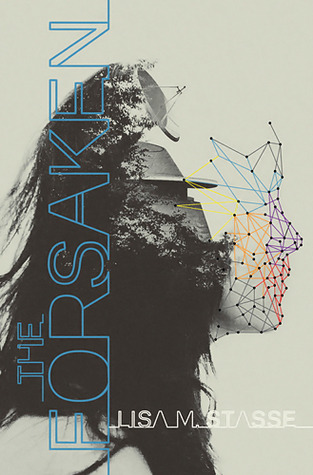
This week I’m waiting for The Forsaken by Lisa M. Stasse (Expected publication: July 10th 2012 by Simon & Schuster Books For Young Readers). It is a 2012 debut, a YA dystopian novel and it sounds awesome!

From Goodreads:

“As an obedient orphan of the U.N.A. (the super-country that was once Mexico, the U.S., and Canada), Alenna learned at an early age to blend in and be quiet—having your parents taken by the police will do that to a girl. But Alenna can’t help but stand out when she fails a test that all sixteen-year-olds have to take: The test says she has a high capacity for brutal violence, and so she is sent to The Wheel, an island where all would-be criminals end up.

The life expectancy of prisoners on The Wheel is just two years, but with dirty, violent, and chaotic conditions, the time seems a lot longer as Alenna is forced to deal with civil wars for land ownership and machines that snatch kids out of their makeshift homes. Desperate, she and the other prisoners concoct a potentially fatal plan to flee the island. Survival may seem impossible, but Alenna is determined to achieve it anyway.”

What are you waiting on this week?

Book of the Week – 7

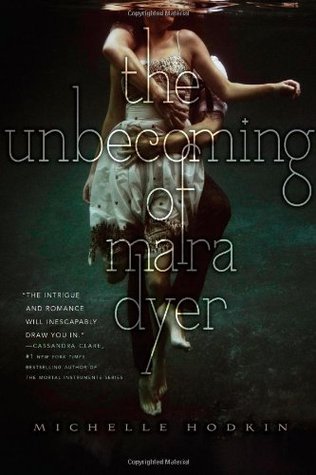
This week I’m reading The Unbecoming of Mara Dyer by Michelle Hodkin. I bought it when it came it out in September 2011 and it has been on my TBR pile since then… So, I know, I’m a bit late to this party, but so far I’m LOVING this book! Can’t wait to finish it…

From Goodreads:

“Mara Dyer doesn’t think life can get any stranger than waking up in a hospital with no memory of how she got there.

It can.

She believes there must be more to the accident she can’t remember that killed her friends and left her mysteriously unharmed.

There is.

She doesn’t believe that after everything she’s been through, she can fall in love.

She’s wrong.”

Check out Michelle Hodkin’s website here.

What are you reading this week?


ROW80 Check-In #6 – Self-editing and dealing with repetitions

Hello gentle reader,

last week I tackled the issue of self-editing a novel (here!) and from your comments I gathered that a lot of us have the same problem: repetitions. When we write, we unconsciously repeat the same words or ideas when really, once is enough. Then, when self-editing our work, we are faced with the issue of dealing with those repetitions.

So here is a 4-step guide to help with reducing unconscious repetitions…

Step 1- Identify overused words

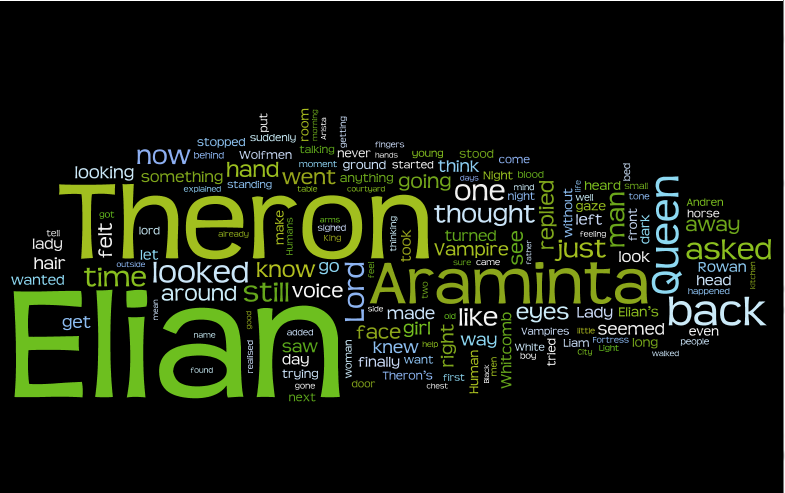
Having a fresh look at your novel or a beta-reader read your WIP is a way to identify overused words. However the best way to know which words are the most frequently used in your manuscript is to use a word cloud generator like Wordle. According to its own website, “Wordle is a toy for generating “word clouds” from text that you provide. The clouds give greater prominence to words that appear more frequently in the source text.”  So in our case, and if you paste your manuscript into Wordle, you will get a word cloud where the words that occur the most in the manuscript are the largest. The largest words in your cloud should be proper nouns.

Here is the word cloud for THE LAST QUEEN, which I’m editing during this ROW80:

See? All the biggest words are my characters’ names. If your largest words are “eyes” or “says”, you might want to have a second look at your manuscript…

Then you can…

Step 2- Identify repetitions of effects

In SELF-EDITING FOR FICTION WRITERS, Browne and King explain:

“Most writers already know to edit out places where they have literally repeated a word or phrase. But the repetition of an effect can be just as problematic. (…) Repetition can rob your writing of its power.” (pp. 175-176).

So you need to check if you have in your manuscript:

–       two sentences that give the same information,

–       two paragraphs that accomplish the same thing,

–       two characters who could be made into one without harming the plot,

–       two chapters that cover the same topic or use the same plot device.

If you do, highlight the repetitions you identify. Once you have done this, you can…

Step 3- Eliminate repetitions

Two is too many…

This is the hardest part. Because this is the time to make choices, to decide what to do with your highlighted words/sentences/paragraphs/chapters. And only you can choose whether to delete or change repetitions.

Step 4- Do a final check

To do so, repeat steps 1 and 2: your word cloud should now only have large proper nouns and you shouldn’t have the same ideas/effects repeated over and over.

That’s it for me. How are you other ROW80 writers doing?

Here is the Linky for the other check-in posts.